Tuesday, September 24, 2013

I Still Remember Joni James

I have a friend named Jack Bilello who wrote a wonderful book called: "I Still Love Joni James: A Boy Grows in Brooklyn". (Actually, Jack is a few years older than me, and it's his brother Joe I'm closer to.) In addition to being a skilled writer, Jack has the memory of an elephant. In the book, he tells the biographical story of his own upbringing in East New York, Brooklyn in the fifties. For me it was like time traveling back to the places of my childhood and meeting once again the people who Jack breathes back to life. They are all thinly disguised characters in a story based largely on the real residents who really walked the streets. 

Jack writes of the neighborhood in charming detail and with an insider's feeling for its diverse inhabitants: "Get up you son-of-a bitch! You miserable bastard! Get up and get ready for church". Senza Denti, in mid-season form, yelled at Little Philly. I said now, you lagnazuna, and I mean it! If you don't go to church I'll kick you out on your Goddamn ear! The entire neighborhood had given her the nickname. Senza Denti, the toothless. Her two front teeth were missing, leaving a serious gap, lost, rumor has it, when her husband, Philly the Fish, had personally and permanently altered her appearance with a right cross to the jaw. Out of respect, everyone called her Senza Denti behind her back only. To her face she was called Frances or Mrs. Montenova." 

Jack, on the Parade Grounds, a ball field near Prospect Park where the better teams in the borough played: "The Brooklyn Parade Grounds, bordering on Prospect Park, contained twelve baseball fields.  Diamonds two through twelve ranged over the expanse of the Parade Grounds, an enormous stretch of green carved with eleven baseball diamonds colliding with each other. Here the lightweights jousted. On these contiguous fields the outfielders of two different teams would frequently get chummy, gabbing back and forth during lulls in the action. These diamonds had no fences, no dugouts, no stands, no water fountains. Scrubville, U.S.A. Diamond One however, other than that emerald shrine called Ebbets Field, sparkled as the most famous baseball diamond in the fourth largest city in the U.S.A. - the beautiful borough of Brooklyn." 

As the family returned from his father's funeral, the main character, Chris, thought about transitioning from son to father:  "Boy oh boy Dad. We always have to listen to your music. His fifteen-year old son fished around for WBAB, rap and hip-hop. Chris, nettled, in retaliation, reflexively popped the selector back to WHLI and Dean Anthony who played the music of Chris' life. Chris gazed out the car window to hide the tears welling in his eyes. He recalled the exact same radio ruckus he had with his father. He thought no one can be a good son until he's been a father. Words leaped into his mind. Thomas Wolfe said you can't go home again. Eugene O'Neill believed you can never leave home. Chris put his money on O'Neill. You can and should go home again, if only to retrieve the priceless memories. He turned to his son. His tears, like the years, had evaporated. OK Jackie, put on your station. But always remember this...I still love Joni James."
This book peeled away the years for me. It reminded me how lucky I am to have been raised in Brooklyn by a loving Italian family in a time when the world was less complicated... a good read for anyone who remembers Joni James.
Note: Some quotes from the book are paraphrased. 

-------------------------------------------------------------------------------

From Jack Bilello's Bio:  
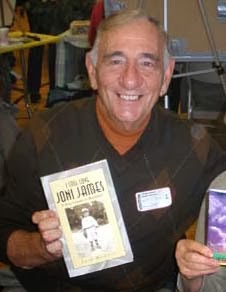
Born, raised and educated in Brooklyn, New York, Jack Bilello, a former Fulbright Scholar and member of Phi Beta Kappa and Kappa Delta Pi (the National Education Honor Society) lives on Long Island with his family. A former Chairperson of History at Lindenhurst, NY public schools, he is currently a field supervisor at Dowling College, Oakdale, Long Island. In addition to his novel, I Still Love Joni James: A Boy Grows in Brooklyn, Bilello has published two previous novels: Bonds of War, a WW II-Vietnam historical fiction was privileged to have its dedication page chosen by the State of Florida’s Veterans Association to honor the American fallen. American Patrol, currently in its second printing, is a suspense action thriller and was a publisher’s nomination for the National Book Award. Both novels are being considered for major motion pictures Three short stories, A Last Chance to be a Boy Again, A Piece of the Heart and Brother’s Keeper are slated for future publication.
CLICK ON DATES AT TOP RIGHT TO SEE OTHER 
“SPALDEEN DREAMS” POSTS.

ALSO, READ MY OTHER BLOG, BRAINDROPS:  http://jpantaleno.blogspot.com/

LOOKING FOR A WORTHY CHARITY? TRY THESE FOLKS: 
Children's Craniofacial Association   http://www.ccakids.com/ 

Wednesday, September 18, 2013

Street Rules

We live in an age where kids no longer get to be kids. Everything they do seems to be scheduled and monitored by hovering parents. They don't get to go outside and play much, and that lack of spontaneous unsupervised interaction with others causes them to lose out on developing one of life's most valuable skills: the art of negotiation. Things were much different growing up in the fifties. Children were on their own pretty much all the time. Our mothers gladly sent us out of the house and the only proviso was to be home by dinner. That is not to say there were no rules on the street to govern our play; there were, but they were rules made up and enforced by kids.

For example, in today's parent-dominated world, every kid who wants to play baseball makes the Little League team. Not only that, but coaches, by league regulation, are mandated to play every kid for at least part of every game. Fifties kids chose up sides, and since the object of playing the game was to win, the best players were always chosen first working down to the less talented kids. Sometimes when the teams reached the player limit, the worst kids got left out. You might think our way was cruel and insensitive, but in a way, it spurred the weaker kids to get better if they wanted to get in the game. This business of everybody plays and winning isn't everything just never occurred to us.

Not all our games relied on brawn. A big pastime for us, especially on cold or rainy days, was flipping baseball cards. We'd go into the hallway of an apartment building and flip cards. The point of the game was to have someone flip say 50 cards and then count up the number of heads and tails. The opponent would then have to match exactly the number of heads and tails flipped to win all the cards. This game required skill, but not muscle. We practiced flipping cards at home, and some kids were so good they could flip 100 straight heads or tails on demand. Side bets of say another 100 cards were often placed over and above the cards being flipped. If there was a tie, each player would toss one card high in the air and leave the outcome to pure chance as it fluttered to the ground.

Other street games required rules. In marbles, when your turn came, the object was to shoot your marble at the marbles of opponents and knock them out of a circle. Those you knocked out you kept. If there was anything in your path between your marble and the one you were shooting at, you were allowed to take a "roundsies". This meant you were allowed to move your marble in an arc around the obstacle (no closer to your target) so that you would have an unobstructed shot. Marbles also had to be standard size; none too big so that it gave the shooter an advantage, and none too small so that they were harder to hit. We played at everything to win, but there was a certain sense of fairness in our street game code.

Squealing was a no-no. Maybe it came from watching too many Cagney movies, but nobody liked a rat. You just didn't squeal on your friends. Teachers would sometimes try to break this vow of Omerta. They'd say: "Okay, if the boy who threw that eraser across the room doesn't come forward, everyone will have to write: "I will not horse around in class 500 times in their notebooks". Silence. If the offender didn't do the honorable thing and step forward, everyone accepted the punishment rather than squeal. That's not to say that later on in the schoolyard we didn't beat the crap out of the kid who caused us all that grief. Strangely the code did not apply to ratting out siblings to our parents. We would throw them under the bus in a heartbeat.

Kids inherently understood that even street games needed rules, and that all had to abide by them if anarchy was to be avoided. Negotiating these rules and their enforcement is what kids miss out on today when every little decision in their lives gets handed down by an adult. 

CLICK ON DATES AT TOP RIGHT TO SEE OTHER 
“SPALDEEN DREAMS” POSTS.

ALSO, READ MY OTHER BLOG, BRAINDROPS:  http://jpantaleno.blogspot.com/

LOOKING FOR A WORTHY CHARITY? TRY THESE FOLKS: 
Children's Craniofacial Association   http://www.ccakids.com/ 

Monday, August 26, 2013

The Lords of Bocce

We were walking recently along the boardwalk in South Beach (not Miami, Staten Island) when we passed what looked like bocce courts. We detoured from our route and came across "The Staten Island Bocce Club". Besides three beautifully maintained bocce courts, there was a gazebo with picnic tables and a tiny garden where the members grew tomatoes and zucchini. As sometimes happens when we come upon a sight that is connected to our past, I was immediately transported in time back to Brooklyn in the 1950s where groups of old Italian men played serious bocce games on the courts in Callahan and Kelly Park on Truxton Street.

For those of you unfamiliar with the game, allow me to elucidate with the help of the World Bocce League website: "Bocce, an ancient sport little known in the United States, has finally begun to take root in the American sports culture. Bocce Ball was first documented in a 5200 B.C. painting of two boys playing, which was discovered by an English scientist, Sir Francis Petrial, in an Egyptian tomb.  In 600 B.C., Bocce was picked up by the Greeks and passed to the Romans. It was played everywhere, from the churches and castles to the city streets. It was Giuseppe Garibaldi  who, while unifying and nationalizing Italy, popularized the sport as it is known today.

Bocce for the average player is very simple. There may be anywhere from two to four to eight players on a team. Players are awarded one point for each ball closer than the opponent's closest ball nearest to the pallino ball (the smallest ball, which has already been thrown onto the field). Each player is given two balls (boccia). A player continues to roll their balls until they get closer than the opponent's ball. Players may also throw on the fly (volo), striking the ball to move the point ball. Balls, including the pallino, may also be displaced by the balls of other players. Bocce is an inexpensive game of thought and strategy that brings families and friends together with the enjoyment of a game that everyone can play."

The men I remember played every day in Callahan-Kelly Park. They wore old pants because of the clay dust kicked up on the courts. They also wore grey cardigan sweaters and brown or grey fedora hats to complete the uniform. Most smoked smelly Di Nobili cigars which they rested on the court railing or in the band of their hat when it came their turn to throw. They always cursed in Italian and gestured wildly for every good or bad throw. If a call was close they invariably took off their belts and used them to measure. If you ever watched a game you would swear the contestants were mortal enemies, but Italians tend to be like that. After the game they would sit on the park benches together and enjoy homemade wine out of glass flasks or eat cherries they had soaked in alcohol.

Bocce is a game that can be enjoyed by anyone. On a recent family reunion picnic we had a game of bocce and it was terrific. Old guys like me played alongside 10 year old boys and we enjoyed ourselves equally. While playing with my sons and cousins, I felt a real connection to the old country. I know my ancestors back in Grassano in Basilicata in southern Italy must have spent some time playing bocce with their families and so we were continuing a long tradition. It must have been very hard for the early immigrants to America who came here with nothing but a dream about a land that promised a better life than the one they left. They banded together with others like them who had come before, living hard lives in overcrowded neighborhoods.  


I'd like to think that a game of bocce brightened some of their afternoons just as the sight of The Staten Island Bocce Club brightened mine so many years later.


CLICK ON DATES AT TOP RIGHT TO SEE OTHER 
“SPALDEEN DREAMS” POSTS.

ALSO, READ MY OTHER BLOG, BRAINDROPS:  http://jpantaleno.blogspot.com/

LOOKING FOR A WORTHY CHARITY? TRY THESE FOLKS: 
Children's Craniofacial Association   http://www.ccakids.com/

Friday, July 19, 2013

A Different World

It's so hard to convey what life was like in the Fifties because the world has changed so much since then. If you were born after 1970, you have seen advances in technology that we never dreamed of. The developments in space exploration, medicine, communications, computers, transportation, even household appliances have been mind boggling. Picture an existence without the Internet, personal computers, microwaves, cellphones, spaceships, lasers, video games, and a host of other developments. Television was in its infancy, yet those wavy images in black and white mesmerized us when we first saw them, probably in a neighborhood store window.

Technology was not the only thing that was different...social customs were a world away. Women were still rare in the workplace; those who had jobs were eyed suspiciously because they weren't housewives doing for their families. They were considered the fairer (but weaker) sex, not fit for the work done by men. Women who went to college were also a rarity. High school girls were taught home economics to prepare them for the life they were expected to lead; housewives. Girls who were unmarried by age 25 set tongues wagging. Couples married young, had a few kids, and the cycle repeated, as it had done for a hundred years.

If you can believe it, race relations were even worse than then they are now. People tended to live in neighborhoods with those of their own race, and even more specifically, those of their own ethnic ancestry. You could almost identify the groups who lived in an area by the kind of stores on the main streets. Italian neighborhoods featured food stores of all kinds, German areas were full of bakeries, black sections by barber shops, fried chicken joints, and storefront churches. Please don't be offended by any perceived negative stereotypical references in this statement; it's just simple fact. Men's social clubs abounded in all neighborhoods where working class stiffs sat around in their undershirts playing cards.

Before television found its voice, people listened to the radio and went to the movies for entertainment. Radio was very different than today. Regular radio programs came on every week with sponsors who understood the power of this medium. Comedy shows, quiz shows, soap operas, sports, adventure and cowboy shows...radio offered the whole gamut. Families would gather around the big console radio in the living room to listen together to their favorite programs. As a boy I would retreat to my room to listen to my personal heroes on the radio...The Lone Ranger, Superman, The Shadow, The Green Lantern and Gene Autry. For a half-hour at a time I was lifted out of my Brooklyn world to join the adventures of these wonderful characters.

Movies too were a much different proposition. Each neighborhood had its theater, the Colonial in my case, where for a quarter you could see two full-length features. The Saturday afternoon special, for the princely sum of fourteen cents, bought you not only two features, but 21 color cartoons and a chapter in one of the ongoing serials like The Thunder Riders or Flash Gordon Goes to Mars. Then there was "dish night" on Mondays, traditionally a slow day for ticket sales. Theaters would give for free to all ticket buyers a piece of china like a dish or cup. Over a period of months, if you went every Monday, you could collect a whole service for eight. Sounds pretty lame now, but those dishes found their way onto many a poor family's table.

For those who didn't live it, our existence might sound a bit threadbare, but I can assure you it was not. We were happy in our circumstances because all around us shared them. There was more interaction among people at all levels before the electronic distractions of today substituted texts and tweets for conversations. At the rate we're going, people of the future will sit in one air-conditioned place, a food tube hooked up to keep them alive, and never take their eyes off that smart tablet for a moment. They will assume Jabba the Hutt-like proportions, never setting foot in the fresh air to go for a walk or swim in the ocean. If you want to talk about a threadbare existence, that sounds like one to me. 


CLICK ON DATES AT TOP RIGHT TO SEE OTHER 
“SPALDEEN DREAMS” POSTS.

ALSO, READ MY OTHER BLOG, BRAINDROPS:  http://jpantaleno.blogspot.com/

LOOKING FOR A WORTHY CHARITY? TRY THESE FOLKS: 
Children's Craniofacial Association   http://www.ccakids.com/

Thursday, July 11, 2013

You Ate What!!

The food police are driving me crazy. Every day there's a new rule I'm supposed to follow. No red meat, don't eat white flour, can't eat fruit with a meal, don't eat after 8 pm, avoid fast food, wine is bad, wine is good...enough already. There are more special diets than you can shake a pork chop at: Atkins, Miami Beach, Weight Watchers, Jenny Craig, Slim-Fast, and all will ultimately fail. Our bodies need all kinds of foods for nutrition, and to fool your body into losing weight by eating grapefruit three times a day is ridiculous. Then there are the supplements being peddled. The great and powerful Dr. Oz tells people to drink dandelion juice while walking backwards clockwise in circles, and the idiots can't order it fast enough...sometimes from Dr. Oz's own website...no conflict of interest there.

When I was growing up, we ate well in spite of not having acre-sized supermarkets and owning refrigerators the size of Buicks. There were no microwave ovens, no lean cuisines, no fast food joints and no Costco warehouses where you could buy 80 frozen burgers at a clip. Our mothers shopped at local stores for meat, fish, bread, eggs, fruit and vegetables. We didn't have a pantry full of snack chips in bags the size of pillows. There were no gallon-sized ice cream containers in our freezers because they would never fit with the six inches of ice built up around the ice cube trays...the only things in the freezer!

We bought what we needed for a few days and used it all; nothing went to waste. Bones, bits and scraps went into soups, omelettes, even pies. (If you never tasted escarole pie or spaghetti pie, your life is sadly incomplete.) I get a kick out of parents who fret when little Madison refuses to eat his or her dinner and demands something else. Our alternatives were peanut butter or go hungry. We ate what was put in front of us, period. There were times when, maybe on days close to Dad's next paycheck, we couldn't afford to buy meat. Not a problem; Mom had a dozen meatless dishes that could give a good steak a run for its money. Pasta with lentils, peas, potatoes, broccoli, eggplant or chick peas. Eggs with peppers, potatoes, spinach, or cheese. They were cheap to prepare, but delicious, nutritious and satisfying.

I hear people ordering meals in restaurants that come with a page and a half of verbal instructions. Can you please ask the chef to make that with no gluten,no wheat, no salt, no peanuts, no dairy and no MSG. Also, can that be baked instead of fried, and instead of the french fries can I have cabbage roots. Can you tell me if these dishes were washed in organic soap? On a recent trip to Italy we had a woman on our tour who carried her own little food packets with her and drove the waiters crazy because she was a vegan. I remember thinking, here we are in one of the world's best places to get great food and this ditz is sprinkling pistachio nuts on her pasta instead of the great sauce that normally accompanied it. 

I'm not chastising people who have legitimate, medically confirmed food allergies and have to watch what they eat, I'm talking about the crowd who has to follow Dr. Oz's latest food commandment just to be trendy. They move from diet to diet and fad to fad hoping to get healthier or lose weight, but they are badly misguided. What it all comes down to is "pie-hole control" ... calories in minus calories burned off exercising equals equals what's left of you. Back in the Fifties, we walked everywhere. Restaurant portions did not feed four. You could not pick up the phone and have bags of food dropped off at your door. You ate real food, fresh-cooked and in moderation. Write that down...it's the secret to good health and a trimmer waistline.

I always got a big kick out of the scene in Woody Allen's movie, "Sleeper" where doctors from the future were discussing how wrong we were in the past to avoid certain foods like hot fudge sundaes which, as they now knew, were actually good for you. "Sleeper" clip


CLICK ON DATES AT TOP RIGHT TO SEE OTHER 
“SPALDEEN DREAMS” POSTS.

ALSO, READ MY OTHER BLOG, BRAINDROPS:  http://jpantaleno.blogspot.com/

LOOKING FOR A WORTHY CHARITY? TRY THESE FOLKS: 
Children's Craniofacial Association   http://www.ccakids.com/

Thursday, June 27, 2013

Summertime, Summertime, Sum Sum Summertime

The end of the grammar school year for us came gradually and not all at once. There were tests to be taken to determine whether we moved on to the next grade. I never felt pressured taking tests in grammar school. My brain functioned pretty well then and the work came easily to me. Once this hurdle was behind us, a change came over the teachers and students alike, a sense of relief that the worst was behind us and there was only clear sailing ahead. Our teachers assigned filler work to keep us busy, and sometimes even let their guard down a bit and spoke of their personal lives. The students were fascinated by these revelations, and enjoyed them immensely. I guess we never thought of them having private lives and that they probably just slept in the coat closet waiting for us to come to school every day.

When I see how casually (and inappropriately) kids dress for school these days, it reminds me of the uncomfortable clothes we wore...white shirts and blue ties for boys, and navy blue jumpers and white blouses for girls who were consigned to the other side of our school building. As the June heat began to suffocate our classrooms, we were allowed (Lord please forgive us) to loosen, but not remove, our ties. The windows were opened with the long wooden pole used to pull them down, and the outside air carrying the promise of summer wafted in. At this point in the school year, teachers knew that mentally, kids were already done with school and eased up a bit on the gas pedal.

At lunchtime the seventh and eighth grade boys would head up Aberdeen Street to the playground to play basketball. Under the blazing sun we would remove our white shirts and ties and break into teams, one team being Shirts (keeping their undershirts on) and the other, Skins, playing bare-chested. We went at it  for nearly an hour, wolfed down our lunches, and returned to class sweaty but not tired. What I wouldn't give for some of that youthful energy now. Once in a while one of the Franciscan Brothers who taught us would join the game. They always played on the Shirts side, but just seeing them remove their heavy woolen habits and strip down to their t-shirts made them somehow more human.

On the last day of school report cards were given out with instructions to have our parents sign the back and return them in September. I always got good grades in grammar school and, along with maybe two other students, was a solid candidate for the "General Excellence" medal awarded at graduation to the best overall student. Then a boy named Anthony Dana transferred to our school in seventh grade and eclipsed us all. Anthony was a tall, gangly kid who was extremely bright. He also claimed to want to enter the priesthood, and I'm sure that helped him beat all of us out for the General Excellence medal. I had to settle for the medal in English which, despite its lesser academic significance, seemed to make my parents proud.

With school behind us, that seemingly endless summer beckoned. No more pencils, no more books, no more teachers dirty looks. We donned our uniforms of dungarees (what jeans were called before they changed the name and tripled the price), Keds sneakers and white t-shirts. Thus attired, we awoke each day to the promise of adventure. We left the house after a breakfast of Cheerios and milk, raced home for lunch when we thought about it, and reluctantly trudged home for dinner the third time our Moms screamed for us to "get in the house this minute." Those Brooklyn summers were enchanted, much the same as those remembered in his books by Mark Twain, an author who really understood boys.

We will probably not perfect time travel in my lifetime, but if I could go back for a day, it would be for one of those basketball games in the park and the sheer exuberance of being that young again.


CLICK ON DATES AT TOP RIGHT TO SEE OTHER 
“SPALDEEN DREAMS” POSTS.

ALSO, READ MY OTHER BLOG, BRAINDROPS:  http://jpantaleno.blogspot.com/

LOOKING FOR A WORTHY CHARITY? TRY THESE FOLKS: 
Children's Craniofacial Association   http://www.ccakids.com/

Monday, June 17, 2013

Look At Me Ma!

Throughout grammar school and high school I played on various organized teams including baseball, basketball, swimming, bowling and track. I was in the church choir and I played trumpet in a drum and bugle corps. Except for an occasional midnight mass around Christmas at which the choir was featured, my parents never witnessed me in action in any of these activities. They never even transported me there, mainly because they didn't have a car. We traveled with our coach on public buses or subways, and almost nobody's parents came to the games unless they were coach's assistants. In fact, we might have even been embarrassed to see our parents in the stands; it just wasn't done.

It's not that my parents weren't interested. They encouraged me to participate in any activity I wanted, and not just to get me out of their hair for a few hours. They knew I enjoyed them, that they helped build me up physically, and that I would learn first hand about sportsmanship and to be part of a team. They were proud of my medals and trophies and displayed them around the house for our relatives and friends to see. They paid for my uniforms and equipment, even though money was always tight. The fact that they never attended my sporting events never really bothered me; I took part for my own satisfaction and to help my teams win. By the time I became a parent, all this changed.

My daughter and sons were involved in many activities. They played on sports teams, took part in Scouting, and joined social and academic clubs in school. For most of the 1970s and 1980s my wife and I lived in the car, driving the kids to wherever they had an activity scheduled. Often one or both of us would stay for the event to cheer our kids on. We sat in the gym, in the bleachers, and in wind-whipped outdoor soccer fields supporting our kids. My wife was severely traumatized on opening day of Little League when she was working the snack bar and was nearly stampeded when they opened the gates to let in the crazed parents and kids. The parents were actually worse than the kids.

Their behavior at baseball and soccer games was shameful. My old coaches would never have tolerated any parents who conducted themselves the way these maniacs did. We were taught to be gracious losers, to always shake hands with the other team after the game, and to not hassle the referees who back then were mostly unpaid volunteers. The parents on my kids' teams were just the opposite. They screamed at the coach if he or she didn't play their child. They berated the poor referees, the other team, sometimes even their own kids if they played badly. One year in the Little League playoffs, there was nearly a bench and bleachers clearing brawl! My wife and I attended as many games as we could, but were mortified at the way these adults set such a horrible example for their kids. 

It's nice that parents want to see their kids at play and show up for the games, but after seeing the way they behaved, we were actually happy when my sons decided not to move up to the next level in Little League. Maybe Mom and Dad had the right idea.

CLICK ON DATES AT TOP RIGHT TO SEE OTHER 
“SPALDEEN DREAMS” POSTS.

ALSO, READ MY OTHER BLOG, BRAINDROPS:  http://jpantaleno.blogspot.com/

LOOKING FOR A WORTHY CHARITY? TRY THESE FOLKS: 
Children's Craniofacial Association   http://www.ccakids.com/


Monday, June 10, 2013

Using Your Imagination: Priceless

I try putting these little notes about growing up in the 1950's out there in the hope that one day some bored kid will read them and marvel at what it was like to grow up in a time when sometimes, all we had to play with came straight from our imaginations. There were no acre-sized Toys 'R Us stores where every conceivable toy was on the shelves, complete with instructions, and safety warnings not to ingest small plastic parts. Fifties kids may have been short on cash, but they had this amazing ability to make games out of nothing. City neighborhoods offered no trees to climb, no streams to fish in and no caves to explore. It took the ingenuity of generations of street kids to invent games that could be played anywhere for free. 

I have returned to this idea often in this blog because it occurs to me that we are depriving modern children from ever having to stretch their brains to create ways to amuse themselves that don't involve televisions, computers, video games and smart phones. It would be interesting to me to fill a room with today's ten-year-olds and give them things like a length of rope, a rubber ball, a stick or an empty cardboard box just to see what games they can improvise. Their lives are so structured and supervised, I wonder if they could do it. Do they ever have time, between organized activities, play dates and incessant homework, to just lay down in the grass and try to see shapes in the fleecy white clouds hanging up in the sky?             

I won't repeat what I've said before about how many games we played using only a rubber ball...known colloquially as a Spal-deen in the hood. Suffice to say there were at least 25 games to amuse us. We spent hours playing games like Hide and Seek, Johnny on the Pony, Red Light-Green Light, Kick the Can, Giant Steps, and Ring-a-levio. Total cost to play: zero. On rainy days we would have Popsicle stick races in the fast-flowing streams of water that raced along the curb in the street. If somebody on the block got a new refrigerator or washing machine, the empty box put out in the trash became a castle or a rocket ship. On snowy days we would "borrow" the sturdy metal garbage can covers from unsuspecting neighbors and use them as sleds.

We would roll an old tire down the hill, sometimes riding in it and staggering around dizzy afterward. Any fence, no matter how high, even those topped with barbed wire, became our Matterhorn. On really slow days we would sneak on the elevated trains that ran out to Jamaica in Queens. Some enterprising soul had pried open the heavy black bars that protected the unattended Fulton Street station just wide enough for skinny kids to fit through. First the crew-cut head, then the torso, and finally the legs passed through the opening. One day, a chubbier kid got his head through, but couldn't fit the rest of himself. The cops were called to get him out, and we all received a stern lecture, but the spectacle entertained the rest of us for a couple of hours. Total cost: free.

The stoop (a flight of steps outside a house) was our permanent hangout. We played cards, sneaked cigarettes, girl-watched, and yelled derogatory remarks at passers-by...all free. As lame as it may sound today, we played a game called "movie star initials" that involved taking turns giving the initials of an unnamed screen star, and having to guess the identity of the actor/actress. We would make small bets on the make or color of the next car to turn the corner. Sometimes in desperation we would join the girls' jump-rope games. They were usually happy to have us thinking we were finally showing some interest in them until we started horsing around and were sent packing with slaps and giggles.

As I read this I shake my head realizing how awful these silly games must sound to today's kids who seem to enjoy themselves only when there is a joystick in hand. My childhood was a delight because everything we needed for a good time we carried around in our heads. Here's to the vanishing power of imagination.


CLICK ON DATES AT TOP RIGHT TO SEE OTHER 
“SPALDEEN DREAMS” POSTS.

ALSO, READ MY OTHER BLOG, BRAINDROPS:  http://jpantaleno.blogspot.com/

LOOKING FOR A WORTHY CHARITY? TRY THESE FOLKS: 
Children's Craniofacial Association   http://www.ccakids.com/

Friday, May 31, 2013

Summer Time and the Living is Sticky

The forecast today is for mid-nineties in New York City. Summer in the city has always been rough. but in the 1950s, air-conditioning existed pretty much in movie theaters only; everywhere else you had to rely on your imagination to keep cool. This was back in the day before casual business dress, so any poor schlub in an office job had to put on a suit and tie and descend into Dante's Seventh Circle of Hell, otherwise known as the NYC subway system. As sweaty commuters stood cheek-to-cheek reading the Miss Rheingold ads, ancient fans would blow very hot air into their faces at 60 miles an hour. Women divided their time between fighting off gropers and keeping their foot-high beehive hairdos from collapsing in the hot Santa Ana winds.

I guess toward the end of the 1950's, office buildings began to install air conditioning, so at least oppressed employees climbing up out of steamy subway stations could get that blast of resuscitating cold air as they hit their building lobbies. People who weren't lucky enough to work in offices got little relief during the long, hot summers. It was especially rough for people like firefighters who had to don 50 pounds of heavy gear to fight fires, or cops who wore those old-fashioned wool police uniforms that buttoned up to the neck. Construction workers and utility workers also suffered (as they still do today) by not only laboring in the heat, but often in holes in the ground that intensified their discomfort. 

Kids too had to find ways to beat the heat. Going to the beach was great if your parents were in the mood to take you. I remember well the ride to Coney Island, first on the A train from our local Rockaway Avenue station to Franklin Avenue where we changed for the elevated Brighton line. The backs of your legs stuck to the straw train seats as you took what felt like an interminable ride to our destination, Coney Island Avenue. Then a walk up narrow streets past the tacky souvenir shops, then under the shade of the boardwalk onto the hot sand where you did the "beach blanket mambo" (stepping on the corners of other people's blankets to avoid scorching your feet) until finally, looming on the hazy horizon, the cool Atlantic ocean appeared.

Kids found other ways to cool off like going to the local playground to romp in the wading pool. This was a bowl-shaped concrete enclosure with shower sprays of water shooting out of openings around the "pool", which held maybe two inches of water. If you fell while frolicking in this cement death trap, a trip to the emergency room was a real possibility. We also opened street hydrants, or Johnnie pumps as we called them, and created our own little asphalt beach. Kids came pouring out of hot brick houses to play in the street. Sneakers were a good idea to help prevent stepping on rocks or broken glass. (See trip to emergency room.) Unsuspecting cars rolling slowly down the block with open windows were considered fair game. Evil boys used tin cans to direct the stream of the water gushing from the hydrant into 1954 Chevys, and then ran like hell.

If putting a man on the moon was ranked as man's greatest challenge, then teaching summer school physics in non-air-conditioned classrooms to disinterested kids who had already failed it once must have come in a close second. I remember enduring this fate in high school. I can still see the anguished face of the poor teacher who had sacrificed, gone to college, and became an educator in the hope of improving young minds. He was reduced nearly to tears by a room full of young thugs who wanted no part of Einstein's Theory of Relativity and who thought Sir Isaac Newton was the guy they named the cookie after. To make matters worse, the class was given at New Utrecht High School, located a few short train stops from Coney Island. We could almost smell the hot dogs from Nathan's wafting in on the breeze coming through the open window.


Anyone reading this might get the mistaken impression that summers in the 1950's in Brooklyn were terrible. In fact, they were glorious, and I wouldn't trade those memories for anything. (OK, maybe for a red,
Jaguar XKE, but nothing else.)

CLICK ON DATES AT TOP RIGHT TO SEE OTHER 
“SPALDEEN DREAMS” POSTS.

ALSO, READ MY OTHER BLOG, BRAINDROPS:  http://jpantaleno.blogspot.com/

LOOKING FOR A WORTHY CHARITY? TRY THESE FOLKS: 
Children's Craniofacial Association   http://www.ccakids.com/

Monday, May 27, 2013

Remembering

Today is Memorial Day, a time to reflect on all the brave men and women who made the ultimate sacrifice to keep America free. We wage war somewhat differently today than in wars past. We have unmanned drones that can be used to take out enemy strongholds, we use technology like satellites, computers, night vision goggles, I even read where we have developed a gun that shoots around corners. But in the end, there are soldiers at the end of those guns who must leave their families and risk their lives so that we may be secure in our beds. Our enemy too is different; they fight for no country and under no flag, hiding behind women and children while they inflict their unspeakable evil in the name of their god.

Growing up I watched the young men from our neighborhood go off to war. I actually envied them as they walked down the aisle in church at Sunday mass in their starched uniforms, their bearing proud, serving their country with honor and courage. It never occurred to me that inside those uniforms were young men who had to go to strange places like Korea and Viet Nam to face other young men bent on killing them. They basked in the admiring glances of young girls and old men who had fought in earlier wars, never knowing if they would ever walk down that church aisle again. They must have been frightened, but they did their duty. When I was growing up, very few challenged the idea of not serving one's country if called; not doing so would mark them as cowards in the street culture that saw war as heroic.

I remember a photo from my mother's album of black and white pictures. It showed my handsome godfather, Rocco Crachi, in his combat uniform, sitting atop an army motorcycle on some battlefield in Europe during World War II. Rocco was my father's best friend, and because he was overseas when I was baptized, his brother Gaspar stood in for him as a proxy at the ceremony. My cousin Frank did a hitch in the army that took him to Grassano in southern Italy, the ancestral town of our family. The only other member of our family circle I can remember actively serving in the military was my cousin Peter Caruso, who served in the navy. Pete lived in the apartment above us and I believe was aboard a destroyer in the East China Sea. Thankfully, all came home unscathed, at least physically.

I served 8 years in the army reserve, and the most exotic place I visited was San Antonio, Texas. The only real danger I faced was making it out of the border town bars in Mexico in one piece. I served after Korea and before Viet Nam, so I don't know what it feels like to come under enemy fire. I can only imagine how terrifying it must be to have bombs exploding around you and bullets whizzing over your head. Lately, the word hero has been devalued somewhat in my opinion, but soldiers in wartime who face the possibility of death every day still qualify as heroes under the old definition of the term. Ordinary men display extraordinary courage in the most dangerous circumstances, and their deeds are set down by all who witnessed them. Not surprisingly, these heroes who do make it back are reluctant to speak of their experiences. 

World War I was called the war to end all wars. Sadly, that was a wildly optimistic sentiment. What is really different for all the wars we've fought before and since? Germany, Japan and Korea, once our bitter enemies, are now our trading partners. China, Viet Nam and Russia are now popular American tourist destinations. I'm tired of wars. I'm tired of seeing pictures of mothers and children putting small American flags at their husbands' and fathers' graves. All the billions we spend to wage wars could be better spent to alleviate the hunger and suffering in the world, and yet we persist in trying to kill each other in the name of religion, territorial imperatives and ideological differences. I can only pray that my grandchildren will live in a better world and will hear of war only in history books.


CLICK ON DATES AT TOP RIGHT TO SEE OTHER 
“SPALDEEN DREAMS” POSTS.

ALSO, READ MY OTHER BLOG, BRAINDROPS:  http://jpantaleno.blogspot.com/

LOOKING FOR A WORTHY CHARITY? TRY THESE FOLKS: 
Children's Craniofacial Association   http://www.ccakids.com/