Tuesday, December 27, 2011

The Magic of Rye Playland

I smile when youngsters of family and friends mention school graduation trips to places like Europe, the Mediterranean, and yes, Australia! Surely these are wonderful places to visit, and I'm happy for the kids that they have this opportunity. No kid in the 1950's dreamed of traveling to such places. I can remember just one excursion we were permitted to take, and that came in eighth grade. Our destination was Rye Playland in Rye, New York, where we would take a boat ride on Long Island Sound. This may sound pretty tame compared to today's junkets, but we were thrilled. Most of us had never traveled outside the boundaries of New York City, so Westchester County seemed like an exotic destination that promised action and adventure.

Our Lady of Lourdes secured a bus for the trip. If you can imagine this, for a bunch of city kids, even a bus ride was something to look forward to. What made this outing special was that boys and girls would be on the same bus. Again, not a big deal today, but back in the dark days of strict separation of the sexes in Catholic school, it was as if the inmates of the friary were let loose in the convent yard. There was a palpable buzz in the air as the sound of crackling testosterone and hormones filled the air. Brothers and nuns chaperoned, and the look of grim determination on their faces told the world that they knew the mission before them would not be easy. Whiffs of Brylcreme and Old Spice were carried on the breeze, further evidence that the boys on this trip were in full makeout mode.

Another plus was that students were not required to wear school uniforms on the trip. This was probably due less to the school's willingness to relax the rules than it was to preventing the Rye police from quickly identifying any boy who might be arrested. A six-page set of dress guidelines was issued by the school, and as all eighth graders will, we pushed the envelope hard. The guys wore pegged pants, pointy-toed shoes and shirts with flared collars (a sure sign of a future in and out of prison for the wearer). The girls wore dangerously short skirts, Mom's Jean Nate perfume, and yes, lipstick...all clearly meant to inflame boys who were already lusting in their hearts and elsewhere.

The screws managed to keep the throng in check while we were on the bus, but when we arrived at Rye Beach and prepared to board the boat, the wheels began to come off. The boat was a large one and once aboard, we scattered like bugs when the lights went on. Girls broke out the forbidden high heels that were secreted in their bags, and guys whipped out their combs and defiantly swept the backs of their hair into the dreaded D.A. (duck's ass) style that was cause for 10 whacks if you wore it within five blocks of school. Couples began pairing off as if by prearranged signal. Any hidden alcove on the boat became a place to make out. The screws did their best, but they were no match for young love. By the time we got back to the dock, the girls' lipstick was gone and the guys' flare-collared shirts were blotched with Maybelline Plum Perfect.

The return trip on the bus was a subdued one. The chaperones sulked, knowing how miserably they had failed to halt nature's course. Girls wore guys' jackets, as if in open defiance of the "no fraternization" rules. Hands were surreptitiously held across the bus aisle, and even the nuns, God's guardians of feminine chastity, were too tired to rap their knuckles on unsuspecting skulls. It was a liberation of sorts for us kids. It seemed to me that the nuns and brothers treated eighth graders a little differently after the trip. Maybe they set up the whole thing as a kind of rite of passage, kind of like the prison guard who goes out for a cigarette during a conjugal visit.

It may not have been a trip to Europe, but in some way that trip to Rye Playland was special. A bus load of children left in the morning, but a bus full of young adults returned at night.


  CLICK ON DATES AT TOP RIGHT TO SEE OTHER “SPALDEEN DREAMS” POSTS.

LOOKING FOR A WORTHY CHARITY? TRY THESE FOLKS: Children's Craniofacial Association


Tuesday, December 13, 2011

Old School

Sometimes we hear the term 'old school' applied in a pejorative way as in: "Oh ignore him, he's just old school. It bothers me a little because, as I understand it, being old school should be something to make one proud.

Old school people understand the absolute necessity of one generation sacrificing for the next. This was illustrated so well by the immigrants to this country from all races and ethnic groups who worked hard despite an often harsh reception at the hands of their neighbors. They endured prejudice and unfair treatment, worked at menial jobs (often more than one) and by so doing, earned the grudging respect of those around them. Their children received the education they never had, and as a result, their way in the world was made a little easier. So anxious were they to assimilate that they sometimes left behind the rich cultural heritage of their homeland so that nothing would stand in the way of the Americanization of their families. Happily, their children and grandchildren are rediscovering their roots and restoring the old traditions that define who they are.

Old school people know that you can't rely on the government or anyone else to take care of your family. They raise their children to live by the values they themselves learned from their parents. They teach by example such principles as respecting those around you unless they give reason to be treated otherwise; working hard to get what you want in life; extending a helping hand to those less fortunate; living as a responsible citizen by obeying our laws and fighting injustice; and by living within their means, setting something aside for that rainy day we know will come.

Old school people take full responsibility for themselves. They recognize that like no other country, America affords opportunity for those bold enough to grasp it. They don't squander their God-given talent but rather enhance it through formal education and by learning well the lessons taught in the streets. They don't expect to start at the top but are willing to pay their dues until they are worthy of greater things. Setbacks and failures are not things to be laid at the doorstep of others but challenges to be overcome. They are generous enough to lend a helping hand to younger people the same way they were helped on their way up. They do not make excuses and most of all they do not quit

Finally, old schoolers are courteous in an age when manners and civility are taking a beating. When women rightly asserted their right to equal employment and equal treatment under the law, many men abandoned chivalrous behavior toward women as the price to be paid for their equality. This is wrong. Holding a door open or surrendering your seat to a woman or older person is simply common courtesy. I think chivalry, if not done in a condescending manner, is still something most women welcome. Pulling out a chair in a restaurant or respecting elders should not be customs that are abandoned as our society moves toward full equality. Southerners are still old school. They may have lost the Civil War but they have, so much more successfully than northerners, retained the gift of civil behavior.

If these are the things that old school people are derided for, then I am proud to stand with them and suffer the slings and arrows. Old school rules.


CLICK ON DATES AT TOP RIGHT TO SEE OTHER “SPALDEEN DREAMS” POSTS.

LOOKING FOR A WORTHY CHARITY? TRY THESE FOLKS: Children's Craniofacial Association


Wednesday, December 7, 2011

Nuns

If you grew up as I did attending a Catholic grammar school, then you are familiar with nuns. My school was Our Lady of Lourdes in Brooklyn. Children were taught by lay teachers from first to fourth grade. These were formidable women who ranged from saintly (the kind and placid Miss Baumann who exerted such an influence over the young boys in her charge that they would line up on her doorstep in the rain bearing umbrellas, and fight for the honor of escorting her the short distance to school), to malicious (the white-haired, permanently scowling Miss Wall whose special punishment for misbehaving lads was to grasp us firmly by the hair and bang our heads against the slate blackboards.)


Starting in grade five, boys were turned over to the Franciscan Brothers, and girls to the Sisters of Saint Joseph, a community of nuns founded in France in the year 1650. In 1836, a request came from the Bishop of St. Louis, Missouri for Sisters to teach deaf children. He had been advised by a friend in France to "…get the Sisters of St. Joseph because they will do anything". Truer words were never spoken. These nuns were not your modern-day religious women who walk around in pastel colors and penny loafers, no, the nuns at Our Lady of Lourdes were "old school" in the harshest sense of that term. They wore habits that might only be described as starched straight-jackets. And they were feared.


Nuns have been portrayed in movies (Lilies of the Field), plays (Nunsense) and TV shows (The Flying Nun), but I think the characterization that comes closest to the nuns I remember was in the movie Doubt. Meryl Streep plays the forbidding Sister Aloysius Beauvier, a grimly determined grade school principal bent on exposing a priest she believes to be a pedoplile. What made Streep's performance so brilliant was  that she showed us not only the iron will and discipline of  Sister Aloysius, but her repressed softer side that reflects a true love of the children in her care. Girls I knew in school who got to know the nuns saw this side of them, but to us boys, they were all like Rosa Klebb, the villianess with the knife blade in the toe of her boot in the James Bond movie, From Russia with Love.


Our school wisely separated the girls from the boys. Separate classrooms and separate schoolyards...there would be no fraternization while all those young hormones were raging. That was fine with the boys, because we knew that the Sisters of St. Joseph were the Lord's appointed guardians of feminine purity. To them, boys were testosterone-crazed lunatics whose sole mission in life was to sully innocent young girls. (They should only have seen their innocent girls in action in the balcony of the Colonial Theater.) If we wandered too close to one of the girls a watchful nun might just flick us with a left jab that Sugar Ray Leonard would have envied. The guys in my class were more afraid of them than we were of the brothers. I've told this story before, but I'll repeat it here since it fits the theme.

The worst beating I ever got was in 8th grade. Another boy (Michael Miller) and I were carrying a ceramic-like statue of the Blessed Mother balanced on a small table into the 8th grade girls' room down the hall. As we shuffled slowly into the room trying to keep the statue from falling, I craned my neck to get a look at a particular girl when I tripped over the bench seat of a desk that had been left folded down. The statue hung agonizingly in mid-air for a split second before shattering into a thousand pieces. Sister Bonaventura, the most feared nun in the school, had a look of horror on her face and was momentarily frozen like the rest of us. She recovered quickly though and proceeded too beat the hell out of me, all five feet of her. My cheeks redden to this day when I think of my humiliation.

Despite their combativeness, I believe that most nuns, and brothers for that matter, played an important part in educating young people in Catholic schools. People will always cite exceptions to try to demonize them, but most, like Sister Aloysius in the movie Doubt, were good people who took their calling seriously, even if it meant occasionally swatting a malcontent.


CLICK ON DATES AT TOP RIGHT TO SEE OTHER “SPALDEEN DREAMS” POSTS.

LOOKING FOR A WORTHY CHARITY? TRY THESE FOLKS: Children's Craniofacial Association

Wednesday, November 23, 2011

Thanksgiving Rerun

Here's an old blog I'm rerunning for the Thanksgiving holiday:

Thanksgiving is a time when we, like the Pilgrims who started this holiday in 1621, take time out to give thanks for all we have been given. Somehow, what with all the parades, football games, and eating as if we were going to the electric chair at dawn, the "thanking" part tends to get overlooked. Oh sure, we're thankful for our families and friends, good health, living in a great country like the United States...all the big blessings that come to mind, but what about the small things? They deserve our gratitude too. And so, hoping to set a good example and maybe start a trend, I decided to list the top ten small things in life that I'm thankful for:

10. That Rosie O'Donnell is a lesbian so that no guy has to sleep with her.
9. Living in a country where any sound bite in a suit can grow up to be President.
8. Being named "Sexiest Man Alive" by Geezer Magazine.
7. Thanks to organ transplants, we can now have someone else's heart attack.
6. The market's down, but I can still watch Law and Order reruns three times a day.
5. Adam Sandler movies are now available on DVD.
4. There was no "Godfather IV".
3. Our sacred American tradition that allows any pinhead to vote.
2. That Barbra Streisand never had a "wardrobe malfunction."
1. As per the Darwin Awards, some idiots are eventually weeded out of the gene pool.

I am also thankful for all those Macy's parades we took the kids to back in the day. We must have gone for twenty straight years. There we stood outside the Dakota Apartments, huddled against the cold while waiting to see such B-list celebrities as the lip-synching Osmond Family, Eartha Kitt at age 85 on a respirator, and the guy who does Bette Midler's dry cleaning. I got up at 5 am for this? The real parade attraction was the balloons. I don't know how they maneuvered those mammoth things down Central Park West, with the swirling crosswinds on every corner, but it was always a treat to see. The crowd would start buzzing when a particular favorite was still blocks away: "Here comes Snoopy, here comes Snoopy."

The parade was fun when we first started going. People were reasonably polite and respected the fact that those in front had got there early to have a good view. In later years, the Yuppie scum showed up, arriving late with their Starbucks coffee and spoiled-rotten kids. They would push their brats to the curb with no regard for who was in front of them. One year we saw a bunch of them standing on the hood and roof of some poor shlub's car to get a better view. When we hollered at them to get off, they looked at us like we were crazy. To paraphrase an old joke: "What's the tragedy when a bus load of Yuppies goes off the cliff." Answer: "Two empty seats."

Holidays are a special time. They remind us that being with family and celebrating our traditions are what make the day so uniquely American. In that spirit, I wish you and your family a very Happy Thanksgiving.


SEE DATES ABOVE RIGHT FOR OTHER POSTS FROM "Spaldeen Dreams".


LOOKING FOR A WORTHY CHARITY? TRY THESE FOLKS: Children's Craniofacial Association


Saturday, November 19, 2011

If I Had a Hammer

I still do some consulting for my old company, Con Edison. Con Ed employs a lot of people who do demanding, physical work to keep their electric, gas and steam systems working. The company is very safety conscious, and is continually looking for ways to reduce accidents. Interestingly, a high percentage of accidents involves the use of hand tools. This seems strange given all the more dangerous power tools in use. One possible reason for this is that so many of the young people being hired today have little experience using simple hand tools like hammers, wrenches, pliers and screwdrivers. Also, they have little curiosity about how mechanical things work. As kids, we learned early on that because our families could not afford to buy us new toys, we often made our own or repaired broken ones.

Learning to use tools became a necessity for us. I don't think my father ever bought a tool in his life. The few tools he had were scrounged from wherever he could get them and kept in an old shoebox. Every tool had tape wrapped around the handles.  They were chipped, nicked and dented, but we managed. I still have one of his beat-up screwdrivers to this day. My dad Tony was the least handy guy I ever met; he would usually sweet talk our neighbor Frank into doing any real repairs around the house while he talked and drank beer. I think the first time I walked into a Sears hardware department and saw real tools, I was awe struck.

Every kid on my block could hand make a scooter or a carpet gun from scratch. We made wooden bows from tree limbs and fashioned crooked arrows to play Robin Hood. Bicycle repairs were done almost daily since all of us rode second-hand bikes. My first bike was a hand-me-down from my cousin Joan. It would have been humiliating for a guy to ride a girl's bike so I made a crossbar out of wood, and shaped and painted it light blue to match the color of the bike. Problem solved. If we got flat tires, every kid knew how to remove the inner tube from the tire, patch it and remount it on the wheel. Roller skates, sleds, red wagons...we could fix them. We built our own roller hockey goals that we set up over the manhole covers in the street for our very own hockey rinks. The point is that sheer necessity helped us acquire basic hand tool skills that are so lacking today.

One store-bought toy on every Fifties kid's Christmas list for those lucky enough to have parents who could afford it was an Erector Set. For those unfamiliar with it, the Erector Set was a collection of variously shaped metal pieces and the nuts and bolts to assemble different projects like a Ferris wheel or tow truck. The set came with detailed instructions that taught kids how to build things by following a plan. Lincoln Logs were another construction toy that encouraged kids to use their hands. There were kits to build radios, model planes and rockets, even chemistry sets that temporarily deprived some careless boys of their eyebrows. There were no video games, electronic toys, or computers...toys from the Fifties were hands-on! 

I have a friend who as a kid salvaged a used lawnmower engine and some old washing machine belts to turn his two-wheeler into a motor bike. By his teen years he was rebuilding car engines for hot rods. Kids built go carts, carpet guns, tree houses (using salvaged lumber)  and improvised ramps for jumping bikes. Necessity really was the mother of invention. It stands to reason that if you never swung a hammer as a kid, you have a good chance of showing up in your employer's accident statistics as an adult.


CLICK ON DATES AT TOP RIGHT TO SEE OTHER “SPALDEEN DREAMS” POSTS. ALSO, READ MY OTHER BLOG: "BRAINDROPS"

LOOKING FOR A WORTHY CHARITY? TRY THESE FOLKS:
Children's Craniofacial Association

Tuesday, November 15, 2011

Pleasure Island

Fredrick Law Olmstead is known as one of the premier landscape architects and park designers in the world, with Central Park in New York City being the jewel in his crown. A lesser-known Olmstead gem is Prospect Park in Brooklyn, a place that featured prominently in the childhood of so many kids including me. If Central Park was the elegant centerpiece of Manhattan, surrounded by multi-million dollar properties, high-end retail stores and horse-drawn carriages, Prospect Park was the "people's" park. Not to minimize the beauty or grandeur of Prospect Park, but it just seemed more like a neighborhood place than a world renown tourist attraction. Its playgrounds, ball fields, zoo, lake, serene walkways and carousel drew old and young alike to its shady embrace.

My wife was lucky enough to live within walking distance of the park and was a frequent visitor. I wasn't so lucky and had to either take the subway or ride my bike to get there, but it was always worth the trip. One of my favorite attractions was the zoo, not large like the Bronx Zoo, but we got to see exotic animals up close and personal. This was in the days before showcasing animals in more natural settings became popular; sadly, most of them were caged. Even as a kid I sensed there was something wrong with locking up magnificent beasts like tigers, bears and elephants in tiny enclosures for people to gawk at. One exception to this practice was the seal pool. Surrounded by an iron fence, this pool featured space where the seals could swim freely, and concrete platforms where they sunbathed. I loved watching them, and on hot days, wished I could join them.

The ball fields were located on the Parade Grounds. I assume at one time the spot was used for parades, but all I remember is the well-tended baseball diamonds that were used only by organized baseball leagues. The neighborhood ball fields we used were overgrown, strewn with broken bottles and debris and playing on them often produced injuries. The Prospect Park fields were fenced in, carefully mown and raked, and had precisely painted foul lines with real bases. Stepping onto those fields made you feel like a ballplayer. I played varsity baseball for Brooklyn Technical High School, and also in PAL and American Legion leagues, so I had the privilege to play there. Local residents would congregate and watch the games, making it seem even more special.

Another big draw was the lake. Stocked with catfish, the lake was one of the few places a kid could fish without a boat or a lot of equipment. We would use bamboo poles with a bobber that would dip under the water when we got a bite. Pieces of bread or corn kernels served as bait and worked very well. What kid can forget the thrill of landing that first fish. We usually threw them back to be caught another day. The Parks Department also rented row boats and paddle boats for the more adventurous. My father took me out once; it may have been the only time I saw Tony Boots get into a boat. Swimming was prohibited since there were no lifeguards, but that didn't stop many kids from splashing around on a summer day.

No trip to the park would be complete without riding the carousel. You could hear the calliope music filling the air as you approached the enclosed pavilion that housed the ride. Soon you saw the whirling horses, lions and tigers and your step quickened, racing ahead of your parents to get on line to buy your tickets. The exquisitely carved and garishly painted carousel animals were works of art. Some of them moved up and down while they circled, while some remained stationary; no self-respecting boy would ever mount a stationery horse, or worse still, sit in one of the tame bench seats that were clearly designed for grandpas. Spinning around on your steed while waving to your mom, who was hollering at you to NOT reach out for the brass rings, was every boy's idea of pure pleasure.

There were few green spaces in Brooklyn near where I grew up, so you can only imagine the anticipation with which we viewed a trip to Prospect Park. For us, it looked like Pleasure Island must have looked to Pinocchio, but without the consequences that bad boys faced. I am grateful that men like Fredrick Law Olmstead understood the importance of such spaces to city folk, and used their consideriable talents to build them for us.


CLICK ON DATES AT TOP RIGHT TO SEE OTHER “SPALDEEN DREAMS” POSTS. ALSO, READ MY OTHER BLOG: "BRAINDROPS"

LOOKING FOR A WORTHY CHARITY? TRY THESE FOLKS:
Children's Craniofacial Association 


Thursday, November 10, 2011

The Mayor of Union Street

I think one of the reasons I enjoy traveling to Italy so much, apart from the obvious beauty of the place, is that I feel very comfortable around Italians. The men and women I saw on my trips look just like the ones from my old Brooklyn neighborhood. I am not referring to the younger Italians who live in the cities, who look so slim and elegant in their fashionable clothes, but rather the older, country people who inhabit the streets of every small town in Italy. Their brown faces, mended sweaters and the way they gesture with their hands when they talk is so familiar to me.

In my old neighborhood, every block had an old Italian man the residents referred to as "the Mayor" who sat out on his stoop 16 hours a day observing. Among his most important duties were to keep any balls we kids hit into his vicinity, yell profanities in Italian at any kid who was fast enough to retrieve a ball before the Mayor could scoop it up, and rat out any kid who did something bad to the kid's parents. The Mayor was under contract to DiNoboli to smoke only their smelly cigars. The stubs of unfinished cigars would be stashed in the mailbox to be smoked another day. The Mayor's uniform was a simple one: gray cardigan sweater over a white shirt, worn trousers held up with suspenders or a safety pin, scruffy slippers and sometimes an old cap.

Neighbors called the Mayor Zio Nicola or Zio Antonio or some other Italian name, Zio being a term of respect in Italian that translates as uncle. He acknowledged their greetings but rarely smiled unless the greeter happened to be an Italian woman. Then the Mayor became the soul of chivalry, tipping his hat if he was wearing one and exchanging pleasantries in Italian...a regular Marcello Mastroianni. One of the Mayor's favorite pastimes was playing briscola, an Italian card game that involved communicating the contents of your hand to your partner without the other players catching on. Apparently the rules called for wild gesticulating and much cursing. Home made Italian liqueur was frequently served to fuel the debate.

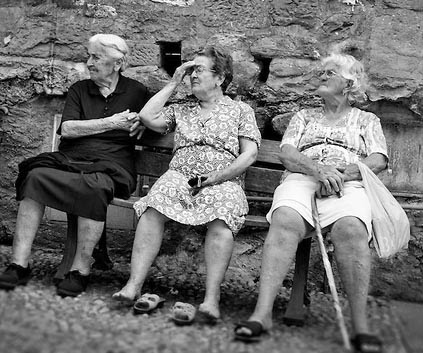
The old Italian women on my street were fixtures too, with their black dresses and grey hair in buns. They rarely went indoors for fear that the other Italian women would talk about them. We used to make money running errands so they wouldn't have to leave their posts on the stoop. In the summer they loved the shaved ices with flavored syrup that were sold off a push cart. Since it would be undignified for them to negotiate this transaction in person, they would give us the money, usually wrapped in an old lace handkerchief, and we would do the deed. Our reward was a few pennies, or if they were feeling generous, they would treat us to an ice and then pump us for gossip about what was going on in our families.


These were displaced people who came to America from Italy and tried to fit in. Many insisted their children learn American ways and they encouraged this by never speaking of their lives in Italy or conversing in their native tongue except among themselves. Their children and grandchildren were poorer for this. My wife's grandfather, Vincenzo Salamo, was the Mayor of Union Street in Park Slope. He would take in all the neighbors' empty trash cans and pick up paper bus transfers which were good for a free ride back then and hand them out magnaminously to people on the block. 

In Italy I saw people in small towns sitting in small groups and talking animatedly. If I closed my eyes I could have been standing on Rockaway Avenue or Fulton Street listening to a spirited debate as to whether Naples or Sicily was the superior birthplace. Viva Italia!     


CLICK ON DATES AT TOP RIGHT TO SEE OTHER “SPALDEEN DREAMS” POSTS. ALSO, READ MY OTHER BLOG: "BRAINDROPS"

LOOKING FOR A WORTHY CHARITY? TRY THESE FOLKS:
Children's Craniofacial Association


Wednesday, November 2, 2011

Neighborhood Character - Fat Sally

Fat Sally was aptly named. He weighed around 300 lbs. and looked at exercise in any form the way you would look at something unpleasant on the bottom of your shoe. Sal also had what used to called a "club foot" and wore an over sized corrective shoe. Completing the picture were hooded eyes and a full head of oily curls that made him look like a slightly dishonest angel. In fact, Sally was slightly dishonest. He fancied himself a "wise guy" but didn't really get into any heavy stuff. He took numbers, but so did every candy store owner in the neighborhood. He was also our illegal fireworks supplier, and did a brisk business selling cherry bombs and ash cans out of his car trunk on July 4th.

Fat Sally's criminal career started early. When we were kids we all played an Italian card game called "brisk". Sally began to organize these games in exchange for skimming a dime from every winning pot. In exchange for this fee, he would bring you (for a small charge) ice cold sodas from the corner grocery store or Italian ices from Roma's pastry shop on Fulton Street. He would also keep an eye out for the cops who actually patrolled a beat back in those days. They were like the mailman; we saw them every day and they knew every kid on the block. They were not above giving you a love tap with their nightsticks if they thought you needed an attitude adjustment.

As he got older, Sally moved on to taking bets on the numbers and also sporting events. As I said, there was plenty of competition in the neighborhood, especially from our local barber who made a lot more money as a bookie than he ever did cutting hair. Fat Sally might have been risking a broken kneecap since the barber was connected to real mob guys, except that he had one big thing going for him...his brother crazy Louie. Here was a serious sociopath. Louie started out as the kid who would eat a bug on a dare. He was violent and totally unpredictable, and even in a neighborhood full of tough street kids, we all gave crazy Louie a wide berth.

Louie, despite his psychopathic tendencies, had a soft side. He served as an altar boy at Mass and at times, seemed deeply religious. How he reconciled these feelings with his penchant for throwing garbage pails through store windows or beating the crap out of people who looked the wrong way at him, I'll never know. Louie was also very protective of his little brother. Knowing this, Fat Sally felt free to act like a total jerk. He would knowingly taunt people, confident that Louie would step in if things got out of hand. Unfortunately, Sal pushed his luck a little too far.

There was a sad character in our neighborhood we called "Eddie Goose". Eddie was like the Lenny character in John Steinbeck's "Of Mice and Men"...brutally strong but gentle as a baby. He was probably schizophrenic, and in the cruel world of kids, that meant teasing and worse. He usually tolerated our taunts, but one day Fat Sally just wouldn't let up. Knowing his big brother was close by, he began hitting Eddie Goose, first on the head, and when Eddie covered up, then in the stomach. Something snapped in Eddie's brain and he turned into The Hulk. Once aroused, his strength kicked in and he quickly put the cowardly Sal on the ground. Crazy Louie stepped in and it turned out to be the worst mistake he ever made. When Eddie was done with him, to quote the great Jim Croce song, he looked like a jigsaw puzzle with a couple of pieces gone.

 In a perfect world, all the Fat Sallys and Crazy Louies would eventually meet their Eddie Goose and get what was coming to them. The world is far from perfect however, although on one day in the 1950s, under the el on Fulton Street in Brooklyn, Karma was king and it was good to see justice done.


CLICK ON DATES AT TOP RIGHT TO SEE OTHER “SPALDEEN DREAMS” POSTS. ALSO, READ MY OTHER BLOG: "BRAINDROPS"

LOOKING FOR A WORTHY CHARITY? TRY THESE FOLKS:
Children's Craniofacial Association


Saturday, October 1, 2011

My Life as a Gay Man

There were a number of words for homosexuals when I was growing up, but "gay" was not one of them. We called them fags, queers, homos, sissies and a lot of other unflattering things. You have to appreciate that although there were gays back in the Fifties, the lifestyle was not exactly embraced. People didn't come out of the closet, they locked it from the inside. I can only imagine how tough life was for them. They couldn't even divulge their secret to their families. The image most men cultivated was the strong, silent type...guys like Gary Cooper, John Wayne and Clark Gable. Ironically, some of Hollywood's most popular stars were gay or bi-sexual but could never admit it: Randolph Scott, Cary Grant, Rock Hudson, Errol Flynn and Tab Hunter come to mind.

What young guy in the Fifties wouldn't have traded places with Rock Hudson or Cary Grant? Strong, handsome, rugged, yet with charm and a sense of humor. Who could blame Doris Day for "going all the way" with them...hell, I might have given it a shot myself! The lifestyle has a certain appeal, after all, men clearly don't understand women, but they understand other men. If only the relationship didn't have to be physical. I have seen the play "La Cage Aux Folles" a number of times and one of the reasons I enjoyed it so much is that they portrayed the gay lifestyle in a very sympathetic light. The characters are likeable and the author told their story in a way that aroused empathy and understanding.

As a kid, I had a couple of unlooked for gay encounters. Once in grammar school a Franciscan Brother kept me after school. He said he wanted to talk to me about something and I readily agreed. In my experience, when you weren't getting hit by these guys, everything else was OK. We were in an empty classroom and this creep sat down next to me and began talking in a very soothing voice. Soon his hand was on my knee and moving North. I was confused and angry that a trusted grownup would touch me this way. I just got up and ran out of the room. We never spoke of the incident.

Another time I was in high school and had fallen into the bad habit of skipping school and going to the movies. My usual truancy-mate, Paddy Jones, was out of school that day so I just went to our local movie theater, the Colonial, on Broadway. It was an early show during the week, so the theater was nearly empty. I was surprised when a man, who could have been the centerfold for Pedophile Magazine, came over and sat down next to me. I was annoyed but not suspicious until the guy put his hand on my inner thigh as casually as if he was reaching for his popcorn. Nobody ever warned us about these pervs back then; homosexuality was a taboo subject and I think Catholics thought they would go to H-E-L-L if they just uttered the word.


By the time I got into the army, I was wiser and warier. I had heard all the jokes about dropping the soap in the shower. We had a communal shower in the barracks, so if you wanted to be clean, you just took your chances. I can say though that if you look in the Guinness Book of Records under the category "Fastest Shower Ever Taken" you will find the name of yours truly.  


CLICK ON DATES AT TOP RIGHT TO SEE OTHER “SPALDEEN DREAMS” POSTS. ALSO, READ MY OTHER BLOG: "BRAINDROPS"

LOOKING FOR A WORTHY CHARITY? TRY THESE FOLKS:
Children's Craniofacial Association


Thursday, September 29, 2011

The Circle Closes

One of the pleasures of childhood was having my family around. I lived with my parents and siblings, but I also lived  with my extended family: grandparents, aunts, uncles, and cousins...there were even Godparents and assorted close friends who, in Italian-American circles, were awarded the honorary title of aunt or uncle. In 1950 I could take a street map of the East New York section of Brooklyn, draw a circle around a two mile radius of our house, and anybody I cared about would have lived inside that circle. Families tended to band together for mutual support. We regularly ate in each other's houses, watched each other's kids, and attended each other's weddings and funerals. Holidays were always spent together...noisy affairs with lined up tables, mis-matched chairs, borrowed dishes and home made wine that the adults gave to the kids, but not before mixing with soda to avoid brain damage.

We were closest with my mother's family; my father's family were all yellers, and when they visited, I ran and hid. Down the block on Somers Street lived my Aunt Anna and Uncle Jim, with their children Frank, Cathy, Anna Marie and Pat. Not far away Aunt Mary and Uncle Nick lived on Fulton Street with their kids, Millie, Nick and Sal. Grandma and Grandpa Camardi and their son Michael lived around the corner on Hull Street. We saw a lot of each other because it was common for even the youngest kids to walk everywhere unescorted. I could be away from home all day and never miss a meal. Aunt Anna lived to feed people. You were never in her house for ten minutes without a meal being placed before you. Historical Note: In exchange for having to put up with Italian men, God gave Italian women the gift of being able to create a delicious meal, virtually out of nothing.

Aunt Mary and Uncle Nick were the family entrepreneurs and worked hard in their quest for riches. Aunt Mary was a gifted seamstress and started up a couple of clothes-making businesses; Uncle Nick was a sweet guy who took his orders from her and cheerfully carried them out. They lived in a second-floor apartment whose windows were about ten feet from the elevated train that ran on Fulton Street. When the trains passed, some furniture in the room actually moved from the vibration. Their son Nick as a boy would sit for hours and bang his head against the back of a club chair. Today they would diagnose him with some disorder like A.D.D., but in fact it was just a phase he was going through. Nick grew up to be a fine husband and father. Their family moved to Selden, Long Island in the early 1960s when there were still buffalo roaming the plains.

Grandpa Pasquale owned a hat blocking and shoe shine store on Rockaway Avenue. On my visits there he would always find some busy work for me to do as an excuse to slip me a dime. I would usually blow it on an ice cold Mission pineapple soda from the red ice chest in front of Louie's Candy Store a few doors away from Grandpa's shop. I took Grandpa's success for granted back then without thinking how hard he had worked to achieve it. He came to America in 1912 with nothing but a dream and an immigrant's work ethic. After many years of struggling, he owned not only his own business, but his and Grandma Caterina's house. As their grandson, I can state with pride that their extraordinary qualities live on in my children.

Today I'd need a 3,000 mile circle to include our family. We are scattered coast to coast and "get together" only on Facebook and e-mail. About five years ago cousin Anna Marie hosted a reunion in New Jersey to which a surprising number of family members came. We had people in their 80s and children under one. It was so good to see them all in person, but the best thing for me was watching cousins who had never met catching up and laughing together, just like we did at all those family dinners. It was as if the circle had been closed.


CLICK ON DATES AT TOP RIGHT TO SEE OTHER “SPALDEEN DREAMS” POSTS. ALSO, READ MY OTHER BLOG: "BRAINDROPS"

LOOKING FOR A WORTHY CHARITY? TRY THESE FOLKS:
Children's Craniofacial Association

Monday, September 26, 2011

*** Spaldeen Dreams # 200 ***

Almost exactly three years ago, inspired by a new friend  from my old neighborhood, I began writing Spaldeen Dreams. I wanted my kids and their kids to have some idea what it was like growing up in Brooklyn when I was young. I think most of us, as we get older, regret not having talked more with our parents and grandparents about their lives before we arrived...I know I do. While it's true that my grandparents spoke little English, if I could have learned some Italian, maybe there would be more stories to tell. I have no excuse for not asking more questions of my parents, except maybe laziness and the arrogance of youth in thinking they had nothing to tell me.

Although I have tried to set down my stories honestly, there may be times when my imagination has filled in the gaps in my memory. If so, it was unintentional.  Sometimes I am dead certain that something is so only to find out it's not. I think we don't want to admit to ourselves that we are starting to forget details; the implications of that are too ominous. Luckily, the ability to do online research to capture information and images of the 1950s helps compensate for aging gray cells. Also working in my favor is the tendency for long term memory to be better than short term. I sometimes see an image or hear a song associated with my childhood, and the memories of the far away past come flooding back.

I have written mostly about small, everyday events as seen through the eyes of a 10-year old. The street games we played (mostly invented for want of money); what school was like and some of the teachers who made a difference;  the magic of radio and its influence on our lives; the movies and TV shows that entertained us; neighborhood characters; family holidays, picnics, and just eating together around the table every evening; my parents, grandparents and other family members; the mistakes I regret and the breaks that lifted me from the streets; my good fortune in marrying the patient and loving partner who helps me be a better person; and my children and granddaughter whose lives, if nothing else, justify my time on earth.

In the days before widespread literacy, family oral histories were a common way to pass along traditions. As more people learned to read and write, these stories and bits of family history began to be documented in family Bibles, annotated family trees, and even photographs. The other day we were looking at old 8mm home movies from 40-50 years ago. My kids are lucky to be able to see themselves as children growing up, as well as images of their "young" parents and others they barely remember. This connects them to those who came before in a very special way. Technology is helping too, with websites like the Ellis Island records archive, the U.S. Census Bureau online, and genealogy researchers like Ancestry.com; I was able to find out so much about my family using these resources.

I loved growing up in 1950s Brooklyn. The world was full of promise and America was leading the way. Things are different now, scarier. I want my little blog to preserve that simple time before cell phones, the Internet, I-pods, plasma TVs, microwave ovens and terrorists. Maybe this is my way of reaching back through the years to recapture lost youth. For whatever reason, I'll continue to write as long as I have something to say. I want to thank my wife for her ongoing help, and those other angels who have encouraged me along the way.


CLICK ON DATES AT TOP RIGHT TO SEE OTHER “SPALDEEN DREAMS” POSTS. ALSO, CLICK THE LINK AT RIGHT TO READ MY OTHER BLOG: "BRAINDROPS"


LOOKING FOR A WORTHY CHARITY? TRY THESE FOLKS:
Children's Craniofacial Association