Tuesday, May 24, 2011

Spin the Bottle

Boys of the Algonquin Indian Tribe of Quebec were brought to a secluded area, often caged, and then given an intoxicating medicine known as wysoccan, an extremely dangerous hallucinogen that is said to be 100 times more powerful than LSD. The intention of the ritual was to force any memories of being a child out of the boy’s mind. Unfortunately some boys also suffer memory loss to the extent that they lose memory of their family, their identity, and even the ability to speak. Some boys who still remembered events from their childhood after returning to the village were then taken back and given a second dose, and forced to attempt to cheat death a second time.  In Brooklyn, we also had our rites of passage, but they were far more civilized.

Maybe the first baby step to manhood was crossing the street alone. As a boy, if you wanted to get to the other side of the street, you tugged on the sleeve of some total stranger and said these words: "Mister, can you cross me?" If your parents were easygoing, they might let an older kid cross you. At some point your parents gave you permission to cross alone, admonishing you to always look both ways. You acted like you were grateful, not having the heart to tell them that you had already been crossing solo for the past two years. Being short of toys, we would play a game to see who could let a passing car get closest to his body. Sometimes we would slap the back fender and fall down as if the driver had struck us. When the poor trembling sap got out of the car, we would tear off howling with laughter. As I said, no toys. 

Another step to manhood involved a feat so dangerous, that in looking back, I shudder to think how stupid we were to try it. The elevated train ran along Fulton Street on its journey out to Jamaica, Queens. I've written before about how we would squeeze through the bars at the unattended end of platform to save the nickel fare. Another way of getting a free ride usually followed a "dare". Accomplishing this feat marked you as fitting material for tribal leadership...if you lived. There was a metal canopy over the stairs leading up to the elevated train station. We would boost ourselves onto this canopy and, like a cat burglar, walk up to where the canopy met the roof of the platform, maybe 40 feet above the street. Scrambling up another level onto the roof, we would carefully lower ourselves down to the platform and wait for the train. As you risked life and limb, your friends would stand down in the street heckling to see if you chickened out. If you made it they called you crazy, an epithet we wore like a badge of honor.

A tougher test had to do with something that we as boys had avoided like the plague up to now...girls. Maybe around fifth or sixth grade, boys come to the realization that those soft, sissy beings that couldn't hit a ball or make a death-defying climb had other things going for them. Suddenly we were acting all goofy around them, desperately wanting their attention and approval for reasons that were as yet unclear to us. Of course this was the first step in the great mating dance between men and women, a dance whose outcome is preordained, but the testosterone raging in our blood prevented us from seeing the end-game. We had feelings and stirrings we didn't understand; we just knew that we wanted these girls to like us, and would violate every rule in the Boys Handbook to get a smile or (rapture) a giggle. 
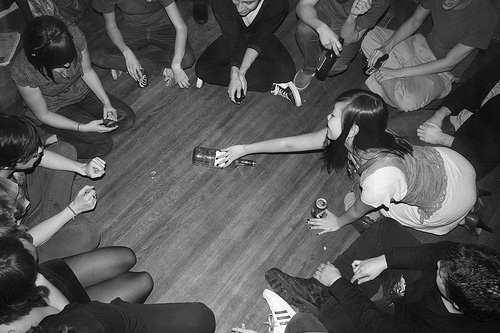
Having no instruction manual on "Getting to First Base", we would have been helpless had it not been for a game called "Spin the Bottle." The game was played at birthday parties in someone's finished basement that had been decorated with balloons and crepe paper streamers. Boys and girls would gather in a circle, and an empty soda bottle would be spun in the middle of the circle. When the bottle stopped spinning, the boy and girl closest to where the neck and base of the bottle pointed had to go into the next room and kiss. The duration and passion of the kiss usually depended on the girl; the guys were more afraid of this encounter than climbing up to the train platform. "The Kiss" ranged from a chaste peck on the cheek to a gum-swapping grope fest that caused blood to flow to places it had never been before.

We were really innocent in the 1950s and in some ways grew up very slowly compared to how quickly kids mature today. Guys stumbled and lurched into manhood, guided only by the tales told by the older boys on the block. Schools wouldn't dare talk about things like s-e-x, and our parents certainly had no stomach for that conversation. Somehow we figured it out though, due in no small part to Spin the Bottle, a game invented by an unsung, social networking genius.


CLICK ON DATES AT TOP RIGHT TO SEE OTHER “SPALDEEN DREAMS” POSTS. ALSO, READ MY OTHER BLOG: BRAINDROPS

LOOKING FOR A WORTHY CHARITY? TRY THESE FOLKS:
Children's Craniofacial Association

Tuesday, May 17, 2011

The Pull of Nostalgia

At least once a week I get an e-mail asking me if I remember the “good old days” when gas was 25 cents a gallon and The Platters were at the top of the music charts. I enjoyed these nostalgia fests when I first started receiving them, but after a while they all start looking the same. Why this obsession with looking back? Do we really miss the things these e-mails talk about or is it our youth we miss ? It’s probably the latter. Folks my age re-live their younger days by circulating these little time capsules that take them back to a time when their mornings didn’t start by opening a little pill box with S-M-T-W-T-F-S printed on top to remind them what day it was.

The older we get and the less we can do, the more we long for the days when we could run full speed for blocks, jump those fences in a single bound, and eat like we were going to the electric chair in the morning without gaining a single pound. Life was in front of us instead of in the rear view mirror. There was high school, maybe college, then a job, marriage, kids, and waaaay off in the future, something called old age. The face in the mirror was free of wrinkles and liver spots and covered with a mop of hair. There was a spring in the step and more than enough energy for whatever needed doing. Sometimes I feel like Rip Van Winkle, waking up after being asleep all those years and finding a world far different from the one I knew.

How did that boy frolicking in the gushing cold spray of the “Johnny pump” become the old geezer who takes 30 minutes just to straighten up in the morning? When did the kid who could hit a pink Spaldeen two sewers and race around the bases in the street turn into the sedentary wreck who drifts from computer to TV room to refrigerator in an endless cycle for 12 hours a day? Where is the carefree lad who could sleep like the dead for 12 hours regardless of what was going on around him? Did he metamorphose into a tossing, turning wretch who dozes fitfully for two hours at a time, always debating about whether to get up to go to the bathroom again?

Age is a funny thing. When we’re young we can’t wait to get older. We get so tired of hearing the words: “No, you’re not old enough.” When can I cross the street alone? When can I light up a cigarette in public? When can I get my license? When will I be old enough?? Well guess what bunky…that’s no longer a problem. Now it’s: What was his name again? What doctor am I seeing today? Can somebody read this menu to me? We get so caught up in life that we don’t always realize how quickly it’s passing by. Suddenly our children are over 40. We can’t eat dinner after 6pm. A day on the golf course is followed by a morning in a hot tub. Now we hear a variation on the words that so frustrated us as kids: “No, you’re too old.” 

Don’t get me wrong, I’m happy to still be here and grateful that modern medicine has progressed so far. Conditions that would have spelled ‘toe tag’ 30 years ago are now treatable, allowing life to be mercifully prolonged. We won’t be twisting the night away like in our Chubby Checker days, but we do get to answer the bell every day and do as much as our creaky frames and feeble brains will allow. I can remember (barely) when my body would do anything I asked of it. At this stage of my life, if the good Lord granted me three wishes they would be: 1) good health for my family; 2) the next six Powerball numbers; and finally, 3) a week back in my 18-year old body. I want to remember what strength and stamina were like. I want to remember life without medications and a good night's sleep. Hell, I’d settle for remembering where I left my car keys!


CLICK ON DATES AT TOP RIGHT TO SEE OTHER “SPALDEEN DREAMS” POSTS. ALSO, READ MY OTHER BLOG: BRAINDROPS

LOOKING FOR A WORTHY CHARITY? TRY THESE FOLKS:
Children's Craniofacial Association


Tuesday, May 10, 2011

A Raisin in the Sun

It's 1958 and I'm heading to the beach. This is not a kiddy trip to the beach with mommy telling you when to eat, when to go in the water, when to get off the rides...no no, this is an unescorted, guys only, maybe-we'll-meet-some-hot-Jewish-girls trip to the beach. I can't wait to smell that first blast of salty ocean air as we step onto the elevated subway platform at Brighton Beach. My preparations have been flawless, like James Bond packing his tux and custom-made silencer for an encounter with Goldfinger. The objective of the trip is to meet girls, and that required equipment, cover stories and of course false papers so you could prove you were 18. The latter also made it easier to prove you were who you said you were when when you lied about being Jewish. It rarely came to this, but a good beach gigolo never takes chances.

We never carried a bag of any kind since, for some reason known only to testosterone-charged teen-aged boys, this was considered "faggy." Everything we needed would be carried in a manly, rolled-up beach towel. Bathing suit (check); long, tapered comb (check); bottle of Wildroot Creme Oil to slick back my D.A. hairstyle after coming out of the water (check); Coppertone suntan lotion (check); tiny transistor radio that, if you were lucky, got one station under ideal weather conditions (check); and if you were feeling extra lucky, a pack of Juicy Fruit gum to take care of that salami breath. Lunch was a problem. We hated carrying bag lunches onto the beach because it just didn't look cool. Would James Dean whip a pepper and egg sandwich out of an oil-stained brown paper bag? But neither did we have the money to buy lunch on the boardwalk, so the compromise was to take lunch from home and eat it on the subway.

Once at our destination (Brighton Beach, Bay 5 where the hot Jewish girls hung out) we rolled out out the beach towel, stepped out of out clothes, and revealed our rippling muscles to the world. OK, maybe they didn't ripple but they did twitch a little. After fiddling with the radio dial until we got something that wasn't static, we then covered ourselves in suntan oil and lay out on that towel like a Cajun Crusted Tilapia until we were done on one side. Burn, flip over and repeat...you could literally smell your skin cooking in that broiling sun. This insane activity was deemed "healthful" in the horribly misinformed 50s, and today I have to listen to my dermatologist lecture me every time I visit. You were happy to hear the approach of the Good Humor man so you could buy a fifteen- cent Humorette (orange or lime creamsicle) to cool off.

At some point we would go on scouting trips to visit the blankets in our search area for young ladies who might be interested in having some company. The search area was the distance you could walk on the burning hot sand without squealing like a girl for relief. A highly prized skill that might expand your search zone was the ability to step on the corners of people's beach blankets as you threaded your way through the minefield of people eating sandy baloney sandwiches washed down with jugs of Kool-Aid. We would use our cheesy but battle-tested pick-up lines like: "Hey Johnny, I think I'm in love" or,  “I’m having a terrible day, and it always makes me happy to see a beautiful girl smile." Nobody was more surprised than us when one of these terrible lines actually worked.

For the record, those rumors about hot Jewish girls proved to be totally unfounded. They were no hotter than the average Christian girl, but that urban myth spread around the high school locker room like wild fire, unfairly elevating our pathetic hopes. We spent many fruitless days searching for girls who "looked Jewish." I've since learned that there is a sure-fire way to tell, but I found out too late to improve our scoring odds. You ask them what they plan to make for dinner and if the answer is "reservations", bingo, hello Shiela. I once took a Jewish girl home to meet my mother. Mom was  Italian and a firm believer in the sentiment expressed in that song from West Side Story, "Stick to Your Own Kind". She was polite to my date, but she looked threateningly at me with Luca Brasi eyes.

  
Now, thanks to all my reckless sunbathing on the beaches of Brooklyn, I had to have some sun damage spots removed from the top of my bald head. If it was up to my doctor, with her SPF85 sunblock and wide brimmed hats, I'd go out on the golf course looking like Miss Marple. I never did find that hot Jewish girl, but I did manage to trick a pretty special Italian girl into marrying me. Mom was so proud.


CLICK ON DATES AT TOP RIGHT TO SEE OTHER “SPALDEEN DREAMS” POSTS. ALSO, READ MY OTHER BLOG: BRAINDROPS

LOOKING FOR A WORTHY CHARITY? TRY THESE FOLKS:
Children's Craniofacial Association


Wednesday, May 4, 2011

My Many Mothers

Mother's Day is coming up, and it got me thinking of my own Mom of course, but also of the other "Moms" who were part of my childhood. In 1950's Brooklyn, the neighborhood was a collection of melting pot families with different ethnicities, races and religions. The one thing many of those families had in common was a strong, loving mother who held the whole shebang together. These remarkable women were the glue of our society. They quietly ruled the house, but usually allowed their husbands to believe they were in charge. The men were grateful for this concession, but deep down knew to whom they reported. Not content to raise only their own children, these women extended their motherly influence to any child who happened to cross their threshold. I was fortunate enough to have regular guidance from a number of auxiliary neighborhood moms.

Tommy Dowd was a good friend and playmate, even though he was about five years older than me. He was a diabetic and small for his size, and that may have explained how he became part of our crowd. Tom's mom Lillian was a lady in the best sense of that word. Her husband worked as a banker and enjoyed a few beers in the evening at Grimm's Bar. I think Lillian just got lonesome sometimes, and would invite the unwashed urchins lounging on her stoop to come in for tea, that's right, tea!  Being English, tea was a familiar ritual to her, and we would sit around her dining room table drinking tea from China cups and eating cinnamon toast or Lorna Doone cookies. Lillian made conversation by asking about our families and how things were going in school. It was an incongruous scene to be sure, but seemed perfectly natural at the time. I'm sure any bit of polish I may have acquired in childhood rubbed off from the genteel Lillian.

Angie Bilello was another surrogate mom who lived across the street from my grandparents on Hull Street. She was the mother of my friend Rich...all sweetness and light unless she thought you were up to something, at which point she would turn into Sgt. Joe Friday and start firing questions designed to break through your pathetic tissue of lies. Angie was a selfless Italian wife and mother who cared not only for her family, but also for a blind brother who lived with them; she did this without complaint. I felt at home in her kitchen because there was always something good to eat. I know my memory can't be right on this, but it seems to me that Angie was always frying veal cutlets! Ah, the smell. This was in the day when you could buy veal cutlets without needing a co-signer for a loan. We ate this Italian heroin like snacks before dinner, sitting at the formica kitchen table with Angie smilingly looking on.

Agnes Bordenga was the Myrna Loy of Somers Street. While the less glamorous mothers wore the mandatory flowered house dress, Agnes dressed up. She was a very attractive woman married to Sal, the coolest guy on the block. I would look for excuses to run errands for Agnes just to be around her. She smoked (something every other mother on the block frowned upon) had a wonderful sense of gaiety just like Myrna Loy. Agnes always treated me kindly despite the really obvious crush I had on her. When their daughter Phyllis (my sister's friend) got older, Agnes and Sal hosted annual New Year's Eve parties, probably just to keep Phyllis home where they could keep an eye on her. They invited the teenage boys from the neighborhood, and allowed us to smoke and even have a glass of beer. This might sound terrible, but we never abused their hospitality; it made us feel so grown up.

There was no escaping the mother's network in 1950's Brooklyn. Each of the women who took it upon themselves to watch over the neighborhood children not only helped them stay out of trouble, but in their own way added to the development of their character. Things are a bit different now. Neighborhoods are different and people look at the world through lenses of fear and suspicion, sadly, not without cause. Lillian's invitations to tea would be reported to Child Welfare; Angie's steady diet of fried veal cutlets would be condemned as unhealthy; and Agnes would be hauled off to jail for permitting teens to smoke and drink in her home. My mother was one of a kind and irreplaceable to me, but in raising me she had some help from the great ladies I mentioned and others I didn't. Happy Mother's Day, Frances.


CLICK ON DATES AT TOP RIGHT TO SEE OTHER “SPALDEEN DREAMS” POSTS. ALSO, READ MY OTHER BLOG: BRAINDROPS

LOOKING FOR A WORTHY CHARITY? TRY THESE FOLKS:
Children's Craniofacial Association


Tuesday, April 26, 2011

The Kennedy Years

We've been watching "The Kennedys" on Reelz TV. The series was originally produced for the History Channel, but they declined to air it since they felt the producer was too harsh on the family, especially poppa Joe. They paint him as a controlling, micro-managing fanatic who would stop at nothing to get one of his sons elected President of the United States. It is rumored that, partly because she has a new book coming out on her family, Caroline Kennedy and the rest of the clan exerted pressure on A&E, the parent company of the History Channel, to yank the series because it portrayed her family as manipulating schemers. I found it ironic that in pulling the rug out from under this fine series, the Kennedys acted in exactly the way the producers characterized them in the show.

But I'm not out to bash the Kennedys; they have suffered enough. I really wanted to write about the crises I lived through during the Kennedy administration. I never really thought about it because it just seemed like part of growing up, but President John Kennedy faced some big time challenges in his short time in office. There were many issues facing the country, and it seemed unfair somehow that all would come to a head on JFK's watch. It was the height of the Cold War, with Russia and the United States circling like two Summo wrestlers over who would be the 800 pound gorilla in the world. Racial tensions were tearing the country apart, and the newly liberated island of Cuba, just 90 miles off our coast, was cozying up to the Russians. It seemed as if real life was playing out like in the movies Dr. Strangelove and Seven Days in May.

First. there was the crisis in Berlin. In November 1958, Soviet Premier Nikita Kruschev issued an ultimatum giving the Western powers six months to agree to withdraw from Berlin and make it a free, demilitarized city. Kruschev and Eisenhower talked but no agreement was reached. In 1961, alarmed by the steady flow of citizens from to East to West Berlin, the border to West Berlin was closed and the Berlin Wall erected. President Kennedy responded by calling up nearly 150,000 National Guardsmen. My Army reserve was on alert but never activated. My pal Lefty from Hull Street was called up with his reserve unit and spent a year in North Carolina making Raleigh safe for Democracy. The Berlin Wall stood until the great Ronald Wilson Reagan made his famous: "Mr. Gorbachev, tear down this wall" speech in 1987.

Most southern states had "separate but equal" rules for whites and blacks in the early sixties for schools and other public facilities. A black student named James Meredith, who had attended an all black junior college for two years, applied in 1960 to get a degree at the University of Mississippi. He was denied entry twice, with the leading opponent being the state governor, Ross Barnett. After winning a case brought on his behalf by the NAACP, Meredith thought the matter had been settled. But Governor Barnett, despite telling President Kennedy and his brother Attorney General Robert Kennedy that he would stand aside, broke his word and incited the locals to riot, resulting in injuries and death. The Kennedys, infuriated at the betrayal, called in the National Guard who led Meredith through the university's door. This was a shameful incident in American history, and JFK, despite knowing he would lose Southern reelection votes, ultimately did the right thing.

With hardly time to catch his breath, Kennedy was up at bat again. In September 1962, after some unsuccessful operations by the U.S. to overthrow the Cuban regime (Bay of Pigs) the Cuban and Soviet governments began to surreptitiously build bases in Cuba for a number of medium-range and intermediate-range ballistic nuclear missiles with the ability to strike most of the continental United States. On October 14, 1962, a United States Air Force U-2 plane on a photoreconnaissance mission captured photographic proof of Soviet missile bases under construction in Cuba. The U.S. announced that it would not permit offensive weapons to be delivered to Cuba and demanded that the Soviets dismantle the missile bases already under construction or completed in Cuba and remove all offensive weapons. Cuba and the Soviets backed down after the United States agreed never to invade Cuba.

I voted for JFK when I was young and foolish, and a registered Democrat. I was greatly saddned when he was killed in 1963. Although history may have taken some of the bloom off the Camelot legend by revealing JFK's human frailties, I think he did a credible job in dealing with all the world-shaking crises he faced in so short a time. I have also gained a measure of respect for his brother Bobby. It was his job to play bad cop to JFK's good cop. Bobby was the hammer in JFK's velvet glove. Together they bullied and cajoled the Congress and the Cabinet, with able assistance from one of the world's greatest political persuaders, Lyndon Baines Johnson. I don't know how anyone stands up to the pressure of being the leader of the free world. I don't envy them their job of running this country, and though I often violently disagree with their policies, I applaud them for having the courage to try.


CLICK ON DATES AT TOP RIGHT TO SEE OTHER “SPALDEEN DREAMS” POSTS. ALSO, READ MY OTHER BLOG: BRAINDROPS

LOOKING FOR A WORTHY CHARITY? TRY THESE FOLKS:
Children's Craniofacial Association 


Monday, April 18, 2011

Brooklyn's Champs-Élysées

A while back I wrote about Atlantic Avenue, one of the neighborhood streets that holds a lot of memories for me. Another is the majestic Eastern Parkway, a broad, tree-lined boulevard that starts around Bushwick Avenue and winds its way through a tangle of ethnic neighborhoods before ending at the Grand Army Plaza entrance to Prospect Park. When I was growing up in the Fifties, a drive along Eastern Parkway was our answer to a stroll along the Champs-Élysées in Paris. The multi-laned street carried traffic from downtown Brooklyn to the Interboro (now called Jackie Robinson) Parkway, and along Atlantic Avenue onto the Belt and Southern State Parkways to the promised land, Long Island.

Eastern Parkway was the world's first six-lane highway, completed in 1874. It had divider islands that separated the main traffic lanes from the local streets. These were planted with beautiful trees and paved with grey stones, and we stood on them waiting for the light to change. For a kid, crossing Eastern Parkway was a big deal, and our parents would have had fits if they knew we were so bold as to try. Brownstone houses, apartment buildings, retail shops and storefront churches lined both sides of the street. In my time, Jews were the primary residents of the area with a scattering of Blacks. A few Orthodox Jews still stubbornly hang on in the Crown Heights section, and an uneasy peace exists between them and the Blacks, who are now the dominant culture.

I spent a good part of my 'yout' just off Eastern Parkway in Callahan and Kelly Park on Truxton Street. We walked from home and sometimes stopped off at the candy store to pick up a new Spaldeen ball, or maybe a bat from the broom factory where they sold thick, red or blue broom handles for fifteen cents. These made perfect stickball bats. We played at the handball courts, where an outline of home plate was painted the height of the strike zone. This was a good variation on street stickball because it only required two kids, a pitcher and a hitter. The area was enclosed by a chain-link fence, and depending where the batted ball hit the fence, it would be a single, double, triple or home run.

Heading along Eastern Parkway toward downtown Brooklyn, we'd pass the live chicken market. I always held my breath to avoid a choking smell that still lingers in my nightmares. There was a junk yard fronted by a run-down store window decorated with hub caps. They sold used car parts...remember this was in the day when people actually repaired their own cars. If you zigged off Eastern Parkway near Carlucci's restaurant where we ate after attending funerals, you could visit Our Lady of Loreto Church on Pacific and Sackman Streets, where I was baptized. There was Miranda's Beer Distributor where my father bought cases of Rhiengold and Piels beer for family celebrations. Farther down was the Eastern Parkway Arena where prize fights were held on Friday nights, and at other times it was used as a roller skating rink.

There were a number of nightclubs along Eastern Parkway, including one whose name escapes me, across from the Brooklyn Botanical Garden. This club was patronized mostly by Blacks, and featured top-name entertainment. I went there a couple of times and, while I felt nervous being one of the few white guys at the bar, it was worth it to see acts like the Platters on stage. There was also a small Cabaret whose claim to fame was a real piano mounted on the roof above the doorway. This fascinated me and I went out of my way to look for it every time we drove by. Eastern Parkway ended at the Grand Army Plaza circle near the Brooklyn Museum and the main branch of the Brooklyn Public Library. We just visited a Norman Rockwell exhibit at the Museum last week. Going back there is like time-traveling and somehow makes me feel young again.

I came across a website NewYork/BrooklynOld.htm that contains so many pictures of places in Brooklyn  that, unlike the Brooklyn Museum, are long gone. It gave me such pleasure to look at them because it's who I am. One of the nicest associations I have of the area is from a street that begins where Eastern Parkway ends...Union Street. It was there that a special girl with a small gap in her front teeth grew up at 909 Union Street. Before we were married I 'd drive along Eastern Parkway to pick her up for our dates. When we returned, her father was waiting at the second story window to be sure we didn't linger too long over our goodnights. Thank you Eastern Parkway for Callahan-Kelly Park, the skating rink, the piano on the roof, and for the best friend I have in the world.


CLICK ON DATES AT TOP RIGHT TO SEE OTHER “SPALDEEN DREAMS” POSTS. ALSO, READ MY OTHER BLOG:  BRAINDROPS


LOOKING FOR A WORTHY CHARITY? TRY THESE FOLKS:
Children's Craniofacial Association


Tuesday, April 12, 2011

The Rear View Mirror

In the car today on the oldies station I heard Elvis Presley singing Hard Headed Woman. Suddenly I saw in my mind those wavy black and white lines they always used on old television shows to signal that a flashback was coming.

I'm playing a short center field the way I always did, daring opposing batters to hit it over my head. I'm twelve years old and, in my mind at least, there is no fly ball I can't run down. At the crack of the bat I instinctively take off in the direction I know the ball will be traveling. After a few long strides, without slowing down, I sneak a look over my shoulder to try to pick up the ball's flight. There it is, soaring toward the fence. I adjust my direction slightly and stick up my glove. I hear the thwack as it hits the webbing. I spin and throw hard on a line to third base. The runner who was going to tag up at second goes half-way to third and goes back. He gives me a grudging 'nice catch' nod as I trot back to my position. I'm good. My body is strong, my reflexes are quick, and I have that unshakable confidence unique to the young.

"Well a hard headed woman, a soft hearted man, been the cause of trouble ever since the world began, oh yeah...." is blaring out of the radio of my 1961 Chevy Impala. Heads turn because the car windows are rolled all the way down as I cruise along Cross Bay Boulevard past the Big Bow Wow Drive-In. I can smell the burgers and hot dogs on the summer breeze as I pull into the lot. I look good in my French-toe shoes, black chinos with the belt in back, and my pink and black shirt that laces-up the front. I take an admiring glance at myself in the gleaming finish of the black car before strolling to the miniature golf course to see if any of the guys are there. I wonder how any of the giggling girls, with their hair in giant rollers under bright aqua scarfs can resist me. I have that unshakable confidence unique to the young.

"Now Adam told Eve, listen here to me, don't you let me catch you messin' round that apple tree, oh yeah..." I couldn't wait to get out of high school; college was definitely not for me. I'm in a dead-end job working as a bank clerk and thinking I have the world on a string. I'm pulling in a sweet $52 a week and spending twice that. The free checking account that the bank gives to every employee is my ticket to living beyond my means. Some of the bad checks I wrote are still out there bouncing. I soon discover credit cards and my finances worsen. As Tennessee Ernie said: Another day older and deeper in debt. My prospects are poor, but I'm having too much fun to realize it. I have that unshakable confidence unique to young.

"Now Samson told Delilah loud and clear, Keep your cotton pickin' fingers out my curly hair, oh yeah..." My best friend Rich has a girl he wants me to meet. She's a friend of his girlfriend JoAnn. Her name is Jasmine, she and JoAnn are classmates at Bishop McDonnell High School on Eastern Parkway in Brooklyn. We meet at JoAnn's house in Richmond Hill. Jasmine seems nice enough and we hit it off pretty well. I am especially impressed with her sense of humor; she laughs at all my jokes. I think we went to a movie and after that had a few dates, but we went our separate ways. Hey, why rush into anything, there are plenty of girls out there and most of them would be happy to date a guy like me. I have that unshakable confidence unique to the young.

"I got a woman, a head like a rock. If she ever went away I'd cry around the clock, oh yeah..." As the light changes and the guy behind me honks, I drift back to reality. I reflect on the ending to my story. It must have been divine intervention that brought me to my senses, and sent me back to the lovely Jasmine. Luckily she saw something in me that even I didn't know was there. She married me, and began the process of turning me into a better man. She sacrificed so that I could finish college at night, get a better job, and make a life for our family. I wanted so much to justify her faith in me.

Whatever I've accomplished in life, I owe to her. Even when I make mistakes she is always there to help me. The only way I can think of to repay her is by trying harder to be the kind of husband she deserves.

CLICK ON DATES AT TOP RIGHT TO SEE OTHER “SPALDEEN DREAMS” POSTS. ALSO, READ MY OTHER BLOG: BRAINDROPS


LOOKING FOR A WORTHY CHARITY? TRY THESE FOLKS: Children's Craniofacial Association


Monday, April 4, 2011

What the Hell is a Gerund?

I recently started teaching a 3-day letter writing class for employees of my old company. These folks are senior customer service reps who must compose written replies to the more complicated inquiries and complaints the company receives, and also to letters written to the Public Service Commission or top executives. I knew going in that it would not be an easy class; if you haven't mastered the basics of grammar, punctuation, capitalization, sentence structure, etc. by the eighth grade, then that ship has sailed. My experience bore out my fears...luckily the company has hundreds of "canned" letters written for almost every imaginable occasion that its employees can use as is or modify slightly as necessary. This limits the amount of original writing they must do.

Going over the rules of grammar took me back to my school days at Our Lady of Lourdes in Brooklyn. Those teachers and Franciscan Brothers drilled us relentlessly from the first grade, and created a solid foundation in the English language that they continued to build on right on up through eighth grade. Starting at ground zero with the alphabet, there were printed white-on-green signs mounted above the blackboard that ran around the perimeter of the room. They contained examples of how to write every letter in upper and lower case script.

We learned the Palmer Method of script writing by doing exercises in making loops and whorls with our scratchy fountain pens, while the teachers stood over our shoulders. By pure, boring repetition we learned how to write out letters in a legible hand by the end of first grade. Today, teaching script writing to kids has become a major issue in grammar schools. "Helicopter Parents", so called because they hover over their children every moment of every day, are up in arms because little Ashley made a scowly face when she tried to write in script. Call out the guard, change the curriculum, my child is struggling and I can't bear to watch! Some pinhead actually wrote a book called: "Handwriting Without Tears". Puh-leeeeze.

By second grade we learned about capitalization, punctuation, and spelling. In third grade we hit the basic parts of speech: nouns, verbs, adjectives. Then we moved on to prepositions, conjunctions, adverbs, infinitives, and gerunds... gerunds, for God's sake. If you asked the average high school graduate what a gerund was, they would probably answer: a small, furry animal that lives in a cage and exercises on a wheel. We not only learned the parts of speech, but how to correctly use them in sentences. By third grade we were diagramming sentences showing their proper construction, the subject, verb, object and all modifiers. This was a foolproof way to learn grammar, but they don't teach it any more because it causes the kiddies to frown.

We took all the English we learned and we wrote. Essays, book reports, friendly letters, business letters...we had homework every night that involved writing out the answers to questions. Our answers had to be not only factually correct, but written logically, using correct spelling, grammar, and sentence structure. I'd bet money that in 1956, the English and writing skills we had after graduating eighth grade in a Catholic grammar school would surpass those of college grads today. Don't take that bet because you'd lose. One of the greatest deficiencies exhibited by modern day job seekers is the inability to write. It's a very sad legacy for young American adults that they can't write nearly as well as mid-Nineteenth Century kids with a fourth grade education.

So thank you Misses Langin, Ruffalo, Wall and Baumann; thank you Brothers Conrad, Francis, and Jude for beating that stuff into our young skulls. We didn't appreciate it then, but you were bestowing on us the priceless gift of literacy. Today we worry more about our kids being happy and having high self-esteem...those things are good up to a point, but can't help them find work if they are illiterate morons.


CLICK ON DATES AT TOP RIGHT TO SEE OTHER “SPALDEEN DREAMS” POSTS. ALSO, READ MY OTHER BLOG: BRAINDROPS


LOOKING FOR A WORTHY CHARITY? TRY THESE FOLKS: Children's Craniofacial Association


Monday, March 28, 2011

Waste Not, Want Not

I like my coffee in a cardboard container instead of a cup. I guess it was all those years of going to the coffee cart at work and drinking coffee out of a container that created this odd habit. When I go to Dunkin Donuts or Starbucks for a coffee to take home, I like to rinse out the container and re-use it once or twice before throwing it away. This not only allows me to drink coffee I brew at home out of a cardboard container, but also gives me a chance to re-use something that is still perfectly usable before throwing it away. My youngest son was recently startled to find that I did this. He wonders why I just don't buy a package of cardboard containers and use a new one when I have coffee at home.

Where am I going with this? Well, I want you (and him) to understand where this habit of thrift developed. I don't think of myself as cheap. The smoke coming off my American Express card should be proof of that. Also, thanks to my wife's love affair with Costco, I have a closet full of cardboard containers, and can well afford to use a new one every time I want a cup of coffee. Its just that my upbringing won't let me. I remember as a kid, nothing in our house was wasted. That wasn't just a quirky habit, that arose from need. My parents could not afford even small extravagances, and never owned a credit card, so the money my father brought home each week had to pay all our expenses. As a result, my mother found ingenious ways to stretch a dollar.

We ate a lot of dinners made with some kind of pasta cooked with other simple ingredients like beans, lentils, peas, escarole and potatoes. (By the way, please don't feel sorry for us...I still enjoy these delicious and nutritious 'paisano' dishes today.) Our dinner glasses were provided courtesy of Welch's Jelly, and our dinnerware was supplemented with china handed out at the local movie house to boost attendance. We couldn't afford soda, so Mom bought little cans of flavored syrup made by Snowcrop. One can of this sugary stuff made two quarts of imitation soda, and started lots of cavities in our unsuspecting teeth. Tupperware was out of our reach, but every empty ricotta container found its way into the cupboard to be reused for storing leftovers. Balls of bakery string, used rubber bands, and pieces of used aluminum foil were in the "junk" drawer for when they were needed.

A lot of our clothes came from Cousins Hand-Me Downs, Inc. That's not a store, but a way for poor families to recycle clothes as the older kids outgrew them. I'd go to a birthday party and see my cousin Sal wearing a favorite old shirt of mine. When crew neck sweaters came into style, I just took my v-neck vest and wore it backwards under my jacket. School lunches came from home...there were no school cafeterias with healthy menus served by ladies in hair nets. Our brown bags dripped oil and reeked of Italian tuna fish, peppers and eggs, potatoes and eggs, onions and eggs, or on a good day, a veal cutlet hero. Spending money came from picking up empty soda bottles and taking them to the candy store, where we always had to argue with the proprietor to convince him we had bought the bottles there before he would cash them in.

I remember my Dad straightening out nails that had bent when he tried to pound them in. He put the straightened nails into his "toolbox", really an old shoebox, to be used again. Mom collected Green Stamps which were given out by certain participating merchants and pasted into books. Books of stamps could be redeemed for nifty items like toasters and beach chairs. The Green Stamp redemption center was on Pitkin Avenue, and I remember how excited Mom would get when we walked down there to get some simple household item she could otherwise not afford. Televisions had vacuum tubes, and when a TV set went "on the fritz" we would go to Louie's candy store where a TV tube testing machine was set up. You pulled the tube out of your television that you thought was burned out and plugged it into the tube tester. If the needle on the machine went into the red zone, it meant the tube had to be replaced. Louie sold replacement tubes and for a couple of bucks, you were back watching Howdy Doody again.


As much as this sounds like a chapter out of Charles Dickens, this is how we were raised. Appliances were fixed, socks were darned, shoes were resoled, and nothing went into the garbage until all the useful life had been squeezed out of it. And so my son, there you have it, the reason your old man re-uses his coffee cups. Mom would have been so proud.


CLICK ON DATES AT TOP RIGHT TO SEE OTHER “SPALDEEN DREAMS” POSTS. ALSO, READ MY OTHER BLOG: BRAINDROPS

LOOKING FOR A WORTHY CHARITY? TRY THESE FOLKS: Children's Craniofacial Association

Tuesday, March 8, 2011

Atlantic Avenue

It starts down near the docks in Brooklyn and snakes its way eastward through preppy Clinton Hill, Downtown Brooklyn, Bed Stuy, East New York (keep your car doors locked for those last two stretches), Woodhaven, and finally stops abruptly at the dreaded Van Wyck Expressway in Ozone Park, Queens, where traffic goes to die. I'm talking of course about the street that is so bound up with my youth...Atlantic Avenue. Back in the day, before shopping malls began sprouting everywhere, people flocked to neighborhood stores strung out along Brooklyn boulevards like Atlantic Avenue, Rockaway Avenue, Fulton Street, and further down, Pitkin Avenue, and Sutter Avenue, the latter two streets referred to casually by the locals as "Jewtown".

Shopping density along Atlantic Avenue waxed and waned, with the heaviest concentration of "name" stores in Downtown Brooklyn, and clusters of local stores strung out all the way to Queens. Back in the 1950s, cars were not as plentiful as they are today, and one of the reasons Atlantic Avenue thrived was great public transportation, All of the city's subway lines had stops along Atlantic Avenue, and many bus lines brought shoppers from outlying areas to spend their money. There was even a Long Island Railroad stop (East New York station) that has since been abandoned and closed down . Back then, the train would leave the gloomy East New York station, re-enter the tunnel under Atlantic Avenue and continue east in practically a straight shot to Jamaica. There was even a trolley that ran along Rockaway Avenue where you could transfer at Atlantic Avenue for eastbound or westbound buses.

There were many prominent landmarks along Atlantic Avenue like the distinctive red brick building known as The 23rd Regiment Armory, at 1322 Bedford Avenue, that was built from 1891-1895 and takes up most of the square block bounded by Atlantic Avenue, Pacific Street, Franklin and Bedford Avenues. The regiment was organized during the Civil War and was housed in a nearby armory on Clermont Avenue from 1873-1895. Another is the Williamsburgh Savings Bank, which stands at the crossroads of Flatbush Avenue and Atlantic Avenues in Fort Greene, where it rises majestically into the Brooklyn sky. At 512 feet, the building's tower is the tallest structure in the borough, and its gilded copper dome and clock have been a familiar sight to Brooklyn residents since 1929.

There was also a mysterious building complex called the House of the Good Shepherd, just off Atlantic Avenue at Hopkinson and Pacific. The Home, whose stated objective was "the reformation of women and the preservation of young girls", became the standard repository for women mostly in trouble with the law. In those days that could include disobeying a husband, drunkeness, failure to pay a debt, etc. It was also a home for wayward girls. The Sisters of the Good Shepherd, who ran the home, did an excellent job of keeping the girls protected by building a ten foot high brick wall topped with barbed wire around the complex. Altar boys from the local churches were recruited to help say Mass in the home, and the tales of wild doings behind those walls ran around the neighborhood like wildfire.

Around Atlantic and Flatbush Avenues stood Bickford's Restaurant, a popular spot that stayed open late and was a favorite stop after a movie date Downtown at the Fox or Albee Theaters. Another restaurant we hung out in was the White Castle on Atlantic Avenue and Highland Place. This was the scene of our infamous arrest for murder as told in an earlier post: View "The Lords of Flatbush". In Queens, further out on Atlantic Avenue, was a joint called Maybe's that served burgers in plastic baskets covered in a mountain of french fries. And of course anytime a birthday rolled around, we would head to a bakery on Atlantic and Vermont called Mrs. Maxwell's. The old owners would decorate cakes in the window so people could watch. It's still at the same location but under new management. I have souvenir plaque in my arteries as a grim reminder of Mrs. Maxwell's.

As you drive along Atlantic Avenue today, there are remnants of the old street, but it has changed greatly. You can still see the Williamsburg Savings Bank tower, but I believe it has been converted to condos. The Armory is still there looking much like it did in the 1950s, but its really not safe to walk there any more. The House of the Good Shepherd is a housing project. In the past five years, Atlantic Avenue has undergone a renaissance, with big box stores like Target and Best Buy coming into the old downtown area. There is also the Atlantic Yards project, under which, after much misguided resistance on the part of local residents, the new Barclay's Center Arena and shopping complex will be constructed. It will serve as the new home for the New York Nets basketball team, and will revitalize an area that had fallen on very hard times.

If I close my eyes and think back, I can picture the walk from my old street corner down Rockaway Avenue to Atlantic Avenue. I would pass Louie's Candy Store, the cigar stand under the el at Fulton Street, Crachi's Drug Store presided over by my godfather Gabriel, my grandfather's hat blocking shop, and across the street, Ariola's Pastry, a neighborhood treasure where they made the best sfogliatelle pastries in the world. This link will give you a virtual tour of the Atlantic Avenue I knew. http://www.forgotten-ny.com/STREET%20SCENES/atlantic/atlantic.html


CLICK ON DATES AT TOP RIGHT TO SEE OTHER “SPALDEEN DREAMS” POSTS. ALSO, READ MY OTHER BLOG: BRAINDROPS


LOOKING FOR A WORTHY CHARITY? TRY THESE FOLKS:
Children's
Craniofacial Association