Sunday, September 4, 2011

Coney Is Back!

It's no secret that Coney Island is bound up with my childhood. In the dark days before Disneyworld, Coney Island was our fantasy world. Even Mom needed some relief from having us underfoot all summer, and when she couldn't take it any more, off we went. Going to the beach wasn't simply a matter of jumping in the car and arriving seaside in 30 minutes. This was an all-day outing that took planning, logistics and courage. We rode the subway carrying our beach blankets, towels, pails and shovels, and of course the brown bags dripping oil from the peppers and eggs or Italian tuna sandwiches. There was also a gallon thermos jug full of grape Kool-Aid that could be filled to the brim for about four cents.

We took the A train to Franklin Avenue. People would snap our pictures as we got off the subway because they didn't see many white people in that neighborhood. We walked up the steps to the elevated Coney Island train that actually had woven straw seats. You can only imagine my mother, and usually one of my aunts, trying to keep tabs on this caravan of kids and baggage. The ride was above ground and we all ran for window seats so we would have a good view of the exotic landscape that was just a twenty-minute drive from home, but seemed to us like another world. We shifted uncomfortably in our straw seats as the bathing suits we wore under our clothes chaffed in the non-air-conditioned cars. At last the tang of salt air told us we were there.

We ran down the train steps, with the slower adults trying to keep up and screaming at us to stay together. The pull of the ocean and the sounds of crashing waves drew us up the narrow streets that led to the glorious boardwalk. We then slogged through the cool sand under the boardwalk, giggling past the young couples groping each other to the sounds of their new fangled transistor radios. Finally, we hit the sun-splashed beach and broke into a run as the sand turned hot under our feet. Mom would splurge for the fifty cent umbrella rental fee so that the younger kids in the troupe could have a shady place to take their mid-day nap. They slathered us up with Coppertone and turned us loose, hoping not to see us for a few hours.

After a day of diving into the waves, burying each other in the wet sand near the water, and chasing after the Good Humor man who sold ice cream on the beach, we should have been exhausted, but we knew the day was not yet over. After our bathing suits dried, we got dressed and headed across the boardwalk to the Steeplechase Park amusement area. We usually stopped first at one of the custard stands for the best pistachio or banana soft ice cream I've ever had. We were then free to tour the rides in the park. An admission entitled you to so many rides, and they would punch your round ticket for each ride you went on. The Panama Slide, the Airplane Swings, The Wild Mouse and of course the Steeplechase horses that circled the park on a track. It was a ten-year old's heaven on earth.

We recently visited the Coney Island Aquarium. Unfortunately, it was "Screaming Kids Get in Free" day and we didn't hang around for long. We took a stroll on the boardwalk down to Nathan's for lunch. I was most pleasantly surprised to see the beach and the amusement area thriving. After years of hard times, they have cleaned things up and it looked very much like it did when I was a boy. The Cyclone and the Wonder Wheel are still there, and if you squint really hard, it's 1952 again...your vision and hearing are perfect, nothing hurts, and you can leap tall buildings in a single bound. But back to reality; now where is that sun block, and I can't find my eye drops again.

Photo Credit: http://andrewprokos.com/photo/coney-island-cyclone-rollercoaster/


CLICK ON DATES AT TOP RIGHT TO SEE OTHER “SPALDEEN DREAMS” POSTS. ALSO, READ MY OTHER BLOG: BRAINDROPS

LOOKING FOR A WORTHY CHARITY? TRY THESE FOLKS:
Children's Craniofacial Association  


Monday, August 29, 2011

Doubt

As a diversion in the aftermath of Hurricane Irene, we watched the movie "Doubt" set in the Bronx in the 1960s. It's about a Sister of Charity (Meryl Streep) who squares off against a Catholic priest (Philip Seymour Hoffman) over the nun's suspicions of an improper relationship between the priest and a young boy who attends St. Nicholas School where the nun presides as Principal with an iron fist. The movie was wonderfully written and acted, but more to the point of this blog, it released a flood of memories for me about life inside the walls of a Catholic grammar school. Life was much less complicated then; we never knew what lay ahead like the Cuban Missile Crisis, the Kennedy assassination, the exploration of space, and race riots in our streets. My biggest daily worry was not getting smacked around by the screws (Franciscan brothers, Sisters of St. Joseph, and lay teachers) who ruthlessly patrolled the halls of Our Lady of Lourdes School.

Watching "Doubt" was as if someone flipped a switch in my head and I was back in those classrooms. Don't get me wrong...I loved school in spite of the daily threat of bodily harm, but it was an ongoing battle between a boy's temptation to do what you were told not to do (like talking in class) and the consequences of getting caught, as Brother Jude advanced down that classroom aisle with murder in his eyes, always careful to remove his watch lest he damage it on your skull. There were never any hard feelings involved in administering discipline; it was just business. Brother Jude would eagerly join in a game of Triangle (schoolyard baseball) at lunch time and act as if he had never boxed your ears an hour before. The screenwriter for the movie had to experience that world to write a script that so exactly captured the mood of that place and time.

I always say I'm not a big Meryl Streep fan, yet she's been brilliant in every movie I've ever seen her in; Doubt was no exception. She plays Sister Aloysius, a hard-case nun who treats change like the plague. She bemoans the decline in penmanship, and attributes it in part to the introduction of ball point pens. "You have to press down so hard, it makes you write like a monkey" she pronounces. "I'm so sorry I ever even allowed them to use cartridge fountain pens."  The scenes at Sunday Mass were also spot on, as a vigilant nun patrols the aisles of the church administering a sharp smack to the back of the head of any foolish child who dares to talk or fall asleep. Sister Aloysius metes out justice from her school office with malice for all and mercy for none. To a boy caught listening to a transistor radio in class: "Write out the multiplication tables ten times each, and make sure they're legible." No transgression will ever pass Sister Aloysius unpunished.

Father Flynn, played beautifully by Philip Seymour Hoffman, is a victim of Sister Aloysius when her accusing mind and relentless persecution cause him to transfer out of the parish. He so reminded me of some of the more approachable priests from my old church like Father Schaeffer, who looked like JFK and made a real effort to reach out to the young boys of the parish. I saw him once take on a group of punks from outside the neighborhood who tried to crash a school dance. We followed him outside to help, but he needed none as he soon had the tough guys licking their wounds and on the run. It dawned on me that his interest in us, when viewed through the eyes of a Sister Aloysius, might have well ended his career as a priest. I know the Catholic Church had its problems with abusive priests, but the movie left me conflicted about the line between genuine priestly affection and child abuse.

At some point in the film, Father Flynn gives a sermon about gossip. A woman confides to her confessor that she is guilty of gossiping. For her penance he tells her to cut a pillow, go to the roof of her house, and empty all the feathers into the air, then come back to him. She does as she is told, and the priest says to her: "Now go and retrieve all those feathers and put them back into the pillow." That's impossible she says, they are in the air and cannot be retrieved. "And that is gossip" says Father Flynn.  Even the pious and always certain Sister Aloysius tearfully admits to doubts at the end of the movie. A good lesson for us all. Matthew 7:1 Judge Not Lest Ye Be Judged.


CLICK ON DATES AT TOP RIGHT TO SEE OTHER “SPALDEEN DREAMS” POSTS. ALSO, READ MY OTHER BLOG: BRAINDROPS

LOOKING FOR A WORTHY CHARITY? TRY THESE FOLKS:
Children's Craniofacial Association 


Friday, August 12, 2011

Ma, I'm Sick

I want to get something off my chest. When I didn't feel like going to school, I would take advantage of my mother's love for me by feigning illness. I was basically a very healthy kid, so I was rarely genuinely sick. That helped my credibility because when I said I felt sick,  Mom believed me. She would always gauge whether I had a fever by kissing my forehead. Then she'd say: "You don't feel warm, let me get the thermometer." Trusting soul that she was, Mom would always stick it under my tongue and go off to do something. This gave me time to rub the bulb of the thermometer rapidly back and forth across the bed sheet, thereby creating enough heat friction to produce a temperature. Once I overdid it and Mom nearly fell over when she read 105 degrees!

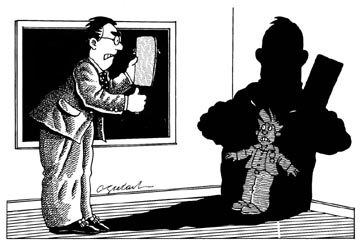
Staying home sick from school was one of the best boondoggles of childhood. I was pampered beyond belief. I felt a little guilty when poor Mom fussed over me, cutting the crusts off my sandwiches, bringing up a stack of comics for me to read, and later on, when we got our first television, fluffing up the pillows on the sofa while I watched mindless cartoons like Junior Frolics, Felix the Cat and Koko the Clown who always crawled out of the inkwell of his creator and onto the screen. Getting control of the TV was a real perk of feigned illness; my sister never got to watch what she wanted. Even if it was a show I enjoyed, I refused to put on any channel she wanted just for spite. Yes, I was a real dick.

Like most Italian and Jewish mothers, the number one remedy for anything that ailed you was chicken soup. This is not a myth but a sacred truth. If there was no other reason to fake illness, getting to eat Mom's chicken soup was reason enough. She made it from scratch with celery, carrots, and rice or small pasta like Orzo. The chicken fat you could skim off the top of the pot was thick enough to lubricate a small battleship, but that's what gave this soup its curative properties. I ate bowl after bowl topped off with Oysterette crackers. If Mom had any suspicions about how a kid who was so sick could have such a voracious appetite, she never let on.

I think by the time I was in high school, Mom had wised up. She packed me off to school no matter how much I whined. This called for a strategy shift; how could I dupe the school nurse into sending me home sick? There were a few "sure-fire" tricks that would get the job done according to some of the seasoned delinquents in my class. One was to put a penny under your tongue along with the thermometer. Other than satisfying any curiosity about what a penny tastes like, this never worked. Another was to put an ink blotter in your shoe. In the days before ballpoint pens, we used ink blotters to keep the blue-black ink in our fountain pens from smearing. Another bust. Finally, I took to just playing hooky and writing excuse notes from home to cover my absences. Yes, I know, a dick.

As a teen, I had a promising career as a forger. For instance, I could draw great replicas of  bus or subway passes and would sell them to kids who had lost their real ones. I could also imitate my mother's handwriting perfectly, and so writing excuse notes was a breeze. This ruse went swimmingly until one time when I made a spelling error on a note, realized it and stuck it in one of my text books. I wrote out another note and it was accepted as usual. Unfortunately, the first note slipped from the pages of my book and some do-gooder found and turned it in. Somehow the attendance office matched up the two notes and the jig was up. My parents were called to school and my poor mother was shocked to find out how many excuse notes she had written. This little caper prompted the guidance counsellor to suggest (demand) that I transfer to another school.

Once in a while I'd stay home sick from work, and found that the thrill of getting away with something had not diminished. I finally wised up and gave up my criminal ways, in fact, later in my career I prided myself on getting to work no matter how lousy I felt. I only wish Mom had been around to witness my redemption.


CLICK ON DATES AT TOP RIGHT TO SEE OTHER “SPALDEEN DREAMS” POSTS. ALSO, READ MY OTHER BLOG: BRAINDROPS

LOOKING FOR A WORTHY CHARITY? TRY THESE FOLKS:
Children's Craniofacial Association


Sunday, August 7, 2011

Juxtaposition of the Incongruous

A couple of weeks ago I taught a three-day writing class for my old company. Nothing really creative, just a refresher in basic grammar, punctuation and structure for an audience of customer service representatives who are in training to become senior customer service representatives. One of the new duties they will pick up if they earn the senior title is writing original letters to customers. Over the years, the company has found a disappointing lack of writing skill in its employees including those in management positions. After day one of the class I heard one student say to another: "So that's what an adverb is." Miss Baumann would be horrified.

I've written before about my fourth grade teacher, Miss Baumann. (We never knew her first name because we would never dream of addressing her so informally) She was one of a group of dedicated teachers at Our Lady of Lourdes School who, for far too little money, took scruffy street urchins and taught them the King's English. Not just enough to get by, but grammatically correct, properly spelled, punctuated, and capitalized English. Our class was not filled with "gifted and talented" kids to merit such a thorough grounding in our native tongue, but in fact, it was expected that every student who graduated that school could write good English. The Catholic school system had never lowered expectations for us just because we were poor or descended from immigrants; there was one high standard and everyone was pushed to meet it.

Trying to teach these skills now, to adults,  is very difficult. It's impossible to do in a three day class what wasn't accomplished in 12 years of formal schooling. These students are not dumb, but their basic elementary and high school education was so fundamentally flawed in that it did not place enough stress on English. What good is math and science if you can't communicate your ideas in writing. The English and writing curriculum have been terribly diluted over the years. People now get college degrees who can't compose a decent resume. As expectations spiral lower and lower, such idiotic books like "Handwriting Without Tears" find their way into our school libraries. We have ourselves to blame for tolerating this erosion; we don't ask enough of our kids, and the result is sadly apparent.

Compounding the schools' failure to teach proper English is the tendency for parents to park their kids in front of a TV or computer and take no interest in their education. Reading to and with kids can be a tremendous help in developing their ear. Listening to our language being spoken properly helps children know what good English sounds like by training their ear. They may not be able to cite the rule that makes a sentence grammatically incorrect, but it will clank on their ear when spoken aloud, and they will know to give it a second look. As it is, they enter adulthood blithely unaware of their inability to write correctly, and become frustrated when the deficiency is called to their attention. Trying to fix it now is nearly impossible, especially in the age of e-mail and "textspeak".

To impress on you just how well those Lourdes English drills sank in, let me relate a little story. I attended college at night while working days to support my family. I was always the oldest in class, but I didn't care. The wonderful gift of English that I had been given by teachers like Miss Baumann served me well. Even in classes in which I wasn't that strong, the professors were so impressed by papers that weren't full of typos, misspellings and grammatical errors that I usually got better grades than I probably deserved. In one class, an instructor asked if anyone knew the literary term for the placement of very dissiimilar elements side by side in the same sentence. Somewhere from the deep recesses of my memory came the answer: "Juxtaposition of the incongruous" I volunteered.

The students turned in their seats staring at me as if I had spoken Swahili. My instructor's jaw dropped a little as he nodded his head to indicate that my answer was correct. The only one who would not have been surprised by my answer was dear Miss Baumann.


CLICK ON DATES AT TOP RIGHT TO SEE OTHER  “SPALDEEN DREAMS” POSTS. ALSO, READ MY OTHER BLOG: BRAINDROPS

LOOKING FOR A WORTHY CHARITY? TRY THESE FOLKS:
Children's Craniofacial Association


Wednesday, July 6, 2011

The Power of Formica

I look at the appliances and gadgets around my house and think about the days when things were much simpler. No exotic coffee makers, (no exotic coffees for that matter), no air conditioning, computers, cell phones, video games, microwaves, none of the things we take for granted in modern life. But we were happy with what we had. I read an article recently about how the 2003 blackout in New York City actually brought families and neighborhoods together because all of the electronic distractions that take up our attention were not available. People actually spoke to each other.

Take the kitchen for example. Now there are all kinds of streamlined kitchen counter configurations with stools and easy-to-make instant meals designed for the convenience of varying family schedules and food preferences. Growing up, I sat with my parents, sister and brother at the Formica and chrome table in the kitchen. We ate the home-cooked meal Mom had made and talked about what went on during our day. I find it funny that psychologists now recommend sitting at the table for family dinners as a way to promote togetherness and quality family time. We did the same thing, but we called it eating.

After dinner we would listen to the radio, or when we finally got one, watch our favorite shows on the RCA black and white TV. I remember feeling happy hearing my mother laugh out loud at the Jack Benny or Red Skeleton Shows. I would watch the Yankee games with my father and talk a little baseball. One of my jobs was to keep him supplied with cold Piels beers. We were apart during the day, what with work and school, and this was our time to be together as a family. I even took a time out from teasing my sister when we watched kiddy shows like Howdy Doody and The Mickey Mouse Club together. Music was played on a multi-speed "Victrola", a turntable that spun 78 rpm vinyl records, and had an adaptor for playing 45 rpms when they came out. No I-pods, no down loads, but it was good enough.

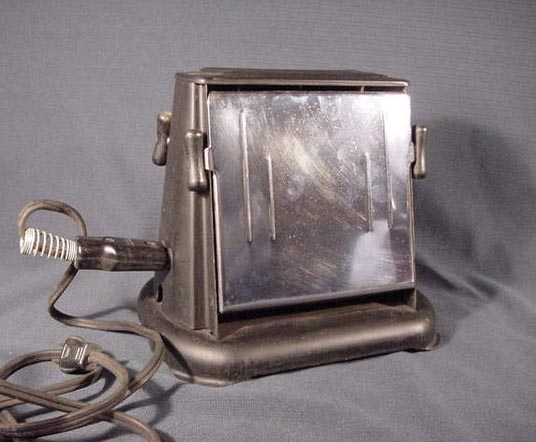
Our refrigerator was a Kelvinator with old-fashioned ice cube trays. No automatic ice maker, no instant cold water, just a box with a tiny freezer that had to be manually defrosted. We survived. For many years my mother did laundry in a wash tub, and hung it out to dry on a clothes line. When we got a washing machine it was a big deal. We never did get a dryer. Somehow, Mom managed. We actually had a toaster with little doors that opened on either side. You placed the bread in, closed the doors, and a heating element toasted the bread. You had to watch it because there was no timer or darkness setting. Smoke billowing out of the toaster meant you had waited too long. Know what...it made better toast than the damn fancy toaster I have now.

Frozen foods were just making their appearance, so everything we ate was fresh from the grocery store. No propane grill in the back yard...we barbecued using  charcoal briquettes and lighter fluid. It wasn't uncommon to see men without eyebrows in the summer. In the days before microwaves, I remember what a splash TV dinners made when Swanson introduced them in 1953. They were a convenience to be sure, but it was the beginning of the end for sit-down family dinners at the kitchen table. Now everybody sat in front of the TV eating off folding trays. One small luxury we had must have been a wedding gift to my parents because we couldn't afford to buy it. It was a Westinghouse electric sandwich press that made the best damn grilled cheese sandwiches I ever ate. 

Funny but it seems like the more modern conveniences that got introduced to our lives, the more isolated we became. Dads heat something up in the microwave when they get home late from work. Kids bring dinner to their rooms so they don't have to be away from Facebook for a whole hour. Mom pops in a Lean Cuisine before heading off to Pilates. Is it possible that a lot of the problems that lead to divorces and broken families could be solved with a Formica table?


CLICK ON DATES AT TOP RIGHT TO SEE OTHER “SPALDEEN DREAMS” POSTS. ALSO, READ MY OTHER BLOG: BRAINDROPS

LOOKING FOR A WORTHY CHARITY? TRY THESE FOLKS:
Children's Craniofacial Association


Thursday, June 23, 2011

July 4th, Brooklyn Style

As the Fourth of July approaches, people prepare to attend spectacular fireworks displays sponsored by such business giants as Macy's or the local town government. These shows are carried out by professional pyrotechnists like the Grucci family of New York, a five-generation, family-owned and operated company on Long Island New York who give 300 elaborately programmed, computer-aided fireworks performances annually all around the world. It wasn't always so. Back in 1950s Brooklyn, fireworks for the Fourth were more of a hands-on affair or, if you'll forgive the pun, hands off if you were careless.

The excitement started mounting maybe in mid-June when that first cherry bomb detonation on the block signalled the arrival of a new illegal fireworks season. I was never quite sure where the fireworks came from, but there were "guys" who, year in and year out could be relied upon to sell fireworks out of their hallway or car trunk. All we knew was that they drove "down south" where fireworks were (and still are) legal, bought a supply of the most popular stuff, and then resold it at a profit in the neighborhood. This was Capitalism pure and simple. The transactions were very clandestine, although back then the cops were a lot more tolerant than today, after all, they were kids once too.

My friends and I would take the wrinkled dollar bills we had saved up and search out the shady characters who peddled this stuff. Once you told them who sent you, like in the old speakeasy days, you were accepted. No thought was given by these bums about the dangers of selling explosives to underage customers. If you had the cash, out came the stash. Cherry bombs, ash cans or M-80s, Roman candles, bottle rockets, pinwheels, firecrackers in packs of twenty and, for the feint of heart, ladyfingers and sparklers. When the big day came, we usually waited until dark to set off our explosions. We didn't just blow them up at random either; they were too expensive to squander. No, we staged elaborate scenes for maximum effect.
Maybe an ashcan (equivalent to about one-quarter stick of dynamite) would be inserted into a ripe watermelon stolen off Steve's horse-drawn cart. (Steve was a junk man in winter and changed hats to sell day-old produce at bargain prices in summer. I doubt he ever hosed out the wagon between career changes.) Sometimes we would roll cherry bombs under cars and run like hell when the owners gave chase. Every year one of us, with no hope of ever becoming a Mensa member, would man-up and hold something dangerous in his hand until the fuse had almost burned down to the powder, just like this kid. http://www.youtube.com/watch?v=iy4juRddaJw  Amazingly, no one was ever seriously hurt, although once, during a Roman Candle fight, "Fankie"s hair caught on fire. We called him Fankie because although his name was Frankie, he couldn't pronounce his Rs. One instant nickname, coming up.

Fireworks were a common way to celebrate Independence Day in most New York City neighborhoods. The cops had murderers to catch and weren't very interested in busting kids for illegal fireworks, as long as you kept it sane. At some point that last proviso was forgotten, but it wasn't us kids who screwed it up, but Neanderthal adults. They would light a fire in a big, cast iron garbage pail out in the street and just sit there lobbing in all sorts of fireworks, hour after hour. Some of these would be blown out of the pail and explode on someone's stoop or front yard. The poster boy for dangerous, over-the-top fireworks displays was John Gotti. Every year the Teflon Don would sponsor such an event in the Howard Beach community. At first the cops left it alone, but as Gotti became more notorious, they shut him down on Mayor Rudy Giuliani's orders.


For me fireworks on the Fourth of July were a part of growing up . They are less commonly seen in New York City neighborhoods these days because of a zero-tolerance crackdown by police. I guess that makes some sense, but I'm glad for the thrills we got from setting off fireworks as kids. To us it was mostly harmless fun (Brooklyn style) and I'm happy to report all fingers and toes are intact.


CLICK ON DATES AT TOP RIGHT TO SEE OTHER “SPALDEEN DREAMS” POSTS. ALSO, READ MY OTHER BLOG: BRAINDROPS


LOOKING FOR A WORTHY CHARITY? TRY THESE FOLKS:
Children's Craniofacial Association

Friday, June 10, 2011

Thanks Brooklyn


In writing this little blog, it’s been a challenge trying to convey what growing up in 1950s Brooklyn was like for those who didn’t live it. It must have been the same for my parents trying to get me to understand what it was like going through the Great Depression of the 1930s; there’s no frame of reference. Every decade has its own feeling I guess. For me, I wouldn’t choose any other time or place to spend my childhood. After WWII and the Korean War, America was poised for one of the greatest periods of technological and economic prosperity ever seen in the world.

Of course none of this mattered to a ten-year old on the streets of Brooklyn. For me the world was bounded by Bushwick Avenue, Pennsylvania Avenue, Pitkin Avenue and Howard Avenue. This small section of Brooklyn called East New York contained everything I needed to be happy. Along with a group of friends whose sense of adventure and curiosity matched my own, we tackled life head-on, making mistakes and learning as we went. Between 1948 and 1958, I was never bored. We had our seasonal activities that came and went as regularly as the seasons themselves.

Spring ushered in baseball season, pea shooter, carpet gun and water pistol wars, card games on the stoop and building homemade scooters from empty wooden fruit crates and recycled roller skates. Summer meant swimming at local beaches and pools, marbles and stickball games, and on those long summer evenings, playing Ring-a-levio and Johnny-on-the-pony until dark. Fall brought basketball and football in the park, roller hockey using a roll of electrical tape for a puck, and long bike trips far beyond the familiar boundaries of the neighborhood. In winter came sleigh riding, building snow forts, collecting and trading comic books, and of course setting fire to a big pile of discarded Christmas trees.

There was always something going on, and if by chance there wasn’t, all I had to do was ring a couple of doorbells. In the age before telephones or television, it didn’t take much to amuse us. If somebody had a pocket knife, a yo-yo or a spinning top, we were good for hours. We weren’t above mischief either. A cranky neighbor who refused to let us retrieve a ball from his yard might find four flat tires on his car. Maybe one of the group would get hold of a couple of cigarettes, a can of beer, some fireworks or even a girlie magazine and the game was on. We would find a deserted hallway, post a lookout, and plunge into the abyss. We sinned knowing that at the end of the week we could confess to Father Gonzalez, secure in the knowledge that he spoke little English and would always absolve us with the customary three Our Fathers and three Hail Marys.

I believe that growing up in the low-tech ‘50s stimulated kids to be active. Everything was hands-on; we explored and experimented rather than sitting back passively waiting to be entertained. This was especially true when school was out for the summer and we had maybe 12 hours to fill. Our mothers didn’t want to see us except for meals, so street games became our Nintendo. We ran wherever we went, so obesity was not a problem. We ate what was put in front of us. I don’t remember a single kid with a peanut allergy. Differences were settled in kid fashion by kid rules, usually without fighting but not always. Parents parented and didn’t overdose hyperactive kids with Ritalin when a smack to the back of the head was a lot cheaper and more effective.

I wonder what kind of a person I would become if I was born today? I am far from perfect, but I can’t help believe that the kind of childhood I was lucky enough to have helped instill in me positive values like hard work, continuous learning, thrift, and appreciation of family. My faults are my own, but my virtues I owe to the streets of 1950s Brooklyn.


CLICK ON DATES AT TOP RIGHT TO SEE OTHER “SPALDEEN DREAMS” POSTS. ALSO, READ MY OTHER BLOG: BRAINDROPS

LOOKING FOR A WORTHY CHARITY? TRY THESE FOLKS:
Children's Craniofacial Association


Monday, June 6, 2011

Deja Vu All Over Again

I love the quote from the inimitable Yogi Berra: "It's like deja vu all over again." That's the feeling I had yesterday as we sat at the 9:00 am Spanish-language Mass at St. Rose of Lima church in Meriden, Connecticut. This is a lovely church in a small town in Connecticut filled with Mexican immigrants, but it could have been Our Lady of Loreto church in 1950s Brooklyn filled with Italian immigrants; the similarities were remarkable.

The entrance procession took a while. It was led by a group of middle-aged Mexican ladies, all seemingly under four feet tall, who were members of the St. Rose of Lima women's sodality. Dressed in red and black, they marched up the aisle, the veiled tops of their heads barely visible through the standing crowd, as they proudly carried their sodality's banners and sang the entrance hymn, in Spanish of course. Their lined, sunburned faces spoke of hard lives, but their faith gave them an inner glow as they basked in the attentions of their friends and family. In Our Lady of Loreto church 60 years ago, the scene would have been exactly the same except that the Italian women would have belonged to the Our Lady of Mount Carmel sodality and their uniforms would have been black and brown. My Aunt Anna was a ranking member of the Daughters of Mount Carmel.. Her manner was normally subservient, but when she marched up that aisle at the head of the sodality, she assumed an air of command that completely transformed her.

Father Jack began the mass in what I assume was fluent Spanish. He is a big man with a shaved head who looks more like a Russian hit man than a man of God, but the congregation's affection for him seems clear and vice-versa. Father Jack moves confidently through the liturgy attended by Mexican altar servers, lectors and singers who look like Munchkins alongside his towering presence. At Loreto, our counterpart to Father Jack was Monsignor Baretta, a small but no less imposing figure who presided over the church in its heyday. The Monsignor could be charming when he had to be, but I think it was his nature to be wary and cunning like a Sicilian Mafiosi. Like all Catholic priests, both men did what they had to do to keep their church vibrant...not always easy in poor neighborhoods where families had all they could do to put food on the table.

In both churches, the presence of families worshiping together was a common denominator, not something we see all that much, at least in our regular Staten Island church...people wearing their Sunday best to Mass... women in dresses, men in jackets and ties, and children scrubbed to within an inch of their lives. I was wearing shorts, and I'm sure the phrase "disrespectful gringo" was uttered more than once. The sense of family was reinforced when it came time to exchange a sign of peace. This took about five minutes as people wandered around the church greeting family and friends. The music was fabulous...a cross between Gregorian Chant and Herb Alpert and the Tijuana Brass. I half expected a Conga line going up to Communion.

At the end of the service, nobody bolted for the door to be first out to the parking lot. Like at Our Lady of Loreto, congregants of St. Rose stayed in their pews until the last bars of the closing hymn. After Mass they mingled, catching up in small groups with goings-on and laughing like they had not a care in the world. Not only Father Jack, but all the ushers, gathered at the rear of the church to greet parishioners and visitors alike. It was interesting watching the mostly Caucasian members of the parish arriving for the next Mass. They seemed to wait inside their cars until all the smiling Mexicans departed, lest they be touched by their joy. African-Americans and Hispanics, in my limited experience, are more joyous in their religious services than up tight white people. My wife and I speak no Spanish, yet we felt like an integral part of that Mass because of the simple faith and celebratory mood of the people.

When you really think about it, twenty-first century Mexican-Americans are not very different from 1950s Italian-Americans. Both groups work hard to make things better for the next generation; education and religion are important parts of their lives; and family trumps everything else. So to the good people of St. Rose, thank you for making us feel welcome and for your reminder that worshiping God does not have to be all gloom and doom. 


CLICK ON DATES AT TOP RIGHT TO SEE OTHER “SPALDEEN DREAMS” POSTS. ALSO, READ MY OTHER BLOG: BRAINDROPS


LOOKING FOR A WORTHY CHARITY? TRY THESE FOLKS:
Children's Craniofacial Association


Tuesday, May 24, 2011

Spin the Bottle

Boys of the Algonquin Indian Tribe of Quebec were brought to a secluded area, often caged, and then given an intoxicating medicine known as wysoccan, an extremely dangerous hallucinogen that is said to be 100 times more powerful than LSD. The intention of the ritual was to force any memories of being a child out of the boy’s mind. Unfortunately some boys also suffer memory loss to the extent that they lose memory of their family, their identity, and even the ability to speak. Some boys who still remembered events from their childhood after returning to the village were then taken back and given a second dose, and forced to attempt to cheat death a second time.  In Brooklyn, we also had our rites of passage, but they were far more civilized.

Maybe the first baby step to manhood was crossing the street alone. As a boy, if you wanted to get to the other side of the street, you tugged on the sleeve of some total stranger and said these words: "Mister, can you cross me?" If your parents were easygoing, they might let an older kid cross you. At some point your parents gave you permission to cross alone, admonishing you to always look both ways. You acted like you were grateful, not having the heart to tell them that you had already been crossing solo for the past two years. Being short of toys, we would play a game to see who could let a passing car get closest to his body. Sometimes we would slap the back fender and fall down as if the driver had struck us. When the poor trembling sap got out of the car, we would tear off howling with laughter. As I said, no toys. 

Another step to manhood involved a feat so dangerous, that in looking back, I shudder to think how stupid we were to try it. The elevated train ran along Fulton Street on its journey out to Jamaica, Queens. I've written before about how we would squeeze through the bars at the unattended end of platform to save the nickel fare. Another way of getting a free ride usually followed a "dare". Accomplishing this feat marked you as fitting material for tribal leadership...if you lived. There was a metal canopy over the stairs leading up to the elevated train station. We would boost ourselves onto this canopy and, like a cat burglar, walk up to where the canopy met the roof of the platform, maybe 40 feet above the street. Scrambling up another level onto the roof, we would carefully lower ourselves down to the platform and wait for the train. As you risked life and limb, your friends would stand down in the street heckling to see if you chickened out. If you made it they called you crazy, an epithet we wore like a badge of honor.

A tougher test had to do with something that we as boys had avoided like the plague up to now...girls. Maybe around fifth or sixth grade, boys come to the realization that those soft, sissy beings that couldn't hit a ball or make a death-defying climb had other things going for them. Suddenly we were acting all goofy around them, desperately wanting their attention and approval for reasons that were as yet unclear to us. Of course this was the first step in the great mating dance between men and women, a dance whose outcome is preordained, but the testosterone raging in our blood prevented us from seeing the end-game. We had feelings and stirrings we didn't understand; we just knew that we wanted these girls to like us, and would violate every rule in the Boys Handbook to get a smile or (rapture) a giggle. 

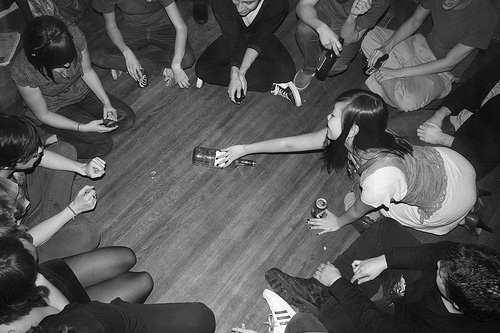
Having no instruction manual on "Getting to First Base", we would have been helpless had it not been for a game called "Spin the Bottle." The game was played at birthday parties in someone's finished basement that had been decorated with balloons and crepe paper streamers. Boys and girls would gather in a circle, and an empty soda bottle would be spun in the middle of the circle. When the bottle stopped spinning, the boy and girl closest to where the neck and base of the bottle pointed had to go into the next room and kiss. The duration and passion of the kiss usually depended on the girl; the guys were more afraid of this encounter than climbing up to the train platform. "The Kiss" ranged from a chaste peck on the cheek to a gum-swapping grope fest that caused blood to flow to places it had never been before.

We were really innocent in the 1950s and in some ways grew up very slowly compared to how quickly kids mature today. Guys stumbled and lurched into manhood, guided only by the tales told by the older boys on the block. Schools wouldn't dare talk about things like s-e-x, and our parents certainly had no stomach for that conversation. Somehow we figured it out though, due in no small part to Spin the Bottle, a game invented by an unsung, social networking genius.


CLICK ON DATES AT TOP RIGHT TO SEE OTHER “SPALDEEN DREAMS” POSTS. ALSO, READ MY OTHER BLOG: BRAINDROPS

LOOKING FOR A WORTHY CHARITY? TRY THESE FOLKS:
Children's Craniofacial Association

Tuesday, May 17, 2011

The Pull of Nostalgia

At least once a week I get an e-mail asking me if I remember the “good old days” when gas was 25 cents a gallon and The Platters were at the top of the music charts. I enjoyed these nostalgia fests when I first started receiving them, but after a while they all start looking the same. Why this obsession with looking back? Do we really miss the things these e-mails talk about or is it our youth we miss ? It’s probably the latter. Folks my age re-live their younger days by circulating these little time capsules that take them back to a time when their mornings didn’t start by opening a little pill box with S-M-T-W-T-F-S printed on top to remind them what day it was.

The older we get and the less we can do, the more we long for the days when we could run full speed for blocks, jump those fences in a single bound, and eat like we were going to the electric chair in the morning without gaining a single pound. Life was in front of us instead of in the rear view mirror. There was high school, maybe college, then a job, marriage, kids, and waaaay off in the future, something called old age. The face in the mirror was free of wrinkles and liver spots and covered with a mop of hair. There was a spring in the step and more than enough energy for whatever needed doing. Sometimes I feel like Rip Van Winkle, waking up after being asleep all those years and finding a world far different from the one I knew.

How did that boy frolicking in the gushing cold spray of the “Johnny pump” become the old geezer who takes 30 minutes just to straighten up in the morning? When did the kid who could hit a pink Spaldeen two sewers and race around the bases in the street turn into the sedentary wreck who drifts from computer to TV room to refrigerator in an endless cycle for 12 hours a day? Where is the carefree lad who could sleep like the dead for 12 hours regardless of what was going on around him? Did he metamorphose into a tossing, turning wretch who dozes fitfully for two hours at a time, always debating about whether to get up to go to the bathroom again?

Age is a funny thing. When we’re young we can’t wait to get older. We get so tired of hearing the words: “No, you’re not old enough.” When can I cross the street alone? When can I light up a cigarette in public? When can I get my license? When will I be old enough?? Well guess what bunky…that’s no longer a problem. Now it’s: What was his name again? What doctor am I seeing today? Can somebody read this menu to me? We get so caught up in life that we don’t always realize how quickly it’s passing by. Suddenly our children are over 40. We can’t eat dinner after 6pm. A day on the golf course is followed by a morning in a hot tub. Now we hear a variation on the words that so frustrated us as kids: “No, you’re too old.” 

Don’t get me wrong, I’m happy to still be here and grateful that modern medicine has progressed so far. Conditions that would have spelled ‘toe tag’ 30 years ago are now treatable, allowing life to be mercifully prolonged. We won’t be twisting the night away like in our Chubby Checker days, but we do get to answer the bell every day and do as much as our creaky frames and feeble brains will allow. I can remember (barely) when my body would do anything I asked of it. At this stage of my life, if the good Lord granted me three wishes they would be: 1) good health for my family; 2) the next six Powerball numbers; and finally, 3) a week back in my 18-year old body. I want to remember what strength and stamina were like. I want to remember life without medications and a good night's sleep. Hell, I’d settle for remembering where I left my car keys!


CLICK ON DATES AT TOP RIGHT TO SEE OTHER “SPALDEEN DREAMS” POSTS. ALSO, READ MY OTHER BLOG: BRAINDROPS

LOOKING FOR A WORTHY CHARITY? TRY THESE FOLKS:
Children's Craniofacial Association


Tuesday, May 10, 2011

A Raisin in the Sun

It's 1958 and I'm heading to the beach. This is not a kiddy trip to the beach with mommy telling you when to eat, when to go in the water, when to get off the rides...no no, this is an unescorted, guys only, maybe-we'll-meet-some-hot-Jewish-girls trip to the beach. I can't wait to smell that first blast of salty ocean air as we step onto the elevated subway platform at Brighton Beach. My preparations have been flawless, like James Bond packing his tux and custom-made silencer for an encounter with Goldfinger. The objective of the trip is to meet girls, and that required equipment, cover stories and of course false papers so you could prove you were 18. The latter also made it easier to prove you were who you said you were when when you lied about being Jewish. It rarely came to this, but a good beach gigolo never takes chances.

We never carried a bag of any kind since, for some reason known only to testosterone-charged teen-aged boys, this was considered "faggy." Everything we needed would be carried in a manly, rolled-up beach towel. Bathing suit (check); long, tapered comb (check); bottle of Wildroot Creme Oil to slick back my D.A. hairstyle after coming out of the water (check); Coppertone suntan lotion (check); tiny transistor radio that, if you were lucky, got one station under ideal weather conditions (check); and if you were feeling extra lucky, a pack of Juicy Fruit gum to take care of that salami breath. Lunch was a problem. We hated carrying bag lunches onto the beach because it just didn't look cool. Would James Dean whip a pepper and egg sandwich out of an oil-stained brown paper bag? But neither did we have the money to buy lunch on the boardwalk, so the compromise was to take lunch from home and eat it on the subway.

Once at our destination (Brighton Beach, Bay 5 where the hot Jewish girls hung out) we rolled out out the beach towel, stepped out of out clothes, and revealed our rippling muscles to the world. OK, maybe they didn't ripple but they did twitch a little. After fiddling with the radio dial until we got something that wasn't static, we then covered ourselves in suntan oil and lay out on that towel like a Cajun Crusted Tilapia until we were done on one side. Burn, flip over and repeat...you could literally smell your skin cooking in that broiling sun. This insane activity was deemed "healthful" in the horribly misinformed 50s, and today I have to listen to my dermatologist lecture me every time I visit. You were happy to hear the approach of the Good Humor man so you could buy a fifteen- cent Humorette (orange or lime creamsicle) to cool off.

At some point we would go on scouting trips to visit the blankets in our search area for young ladies who might be interested in having some company. The search area was the distance you could walk on the burning hot sand without squealing like a girl for relief. A highly prized skill that might expand your search zone was the ability to step on the corners of people's beach blankets as you threaded your way through the minefield of people eating sandy baloney sandwiches washed down with jugs of Kool-Aid. We would use our cheesy but battle-tested pick-up lines like: "Hey Johnny, I think I'm in love" or,  “I’m having a terrible day, and it always makes me happy to see a beautiful girl smile." Nobody was more surprised than us when one of these terrible lines actually worked.

For the record, those rumors about hot Jewish girls proved to be totally unfounded. They were no hotter than the average Christian girl, but that urban myth spread around the high school locker room like wild fire, unfairly elevating our pathetic hopes. We spent many fruitless days searching for girls who "looked Jewish." I've since learned that there is a sure-fire way to tell, but I found out too late to improve our scoring odds. You ask them what they plan to make for dinner and if the answer is "reservations", bingo, hello Shiela. I once took a Jewish girl home to meet my mother. Mom was  Italian and a firm believer in the sentiment expressed in that song from West Side Story, "Stick to Your Own Kind". She was polite to my date, but she looked threateningly at me with Luca Brasi eyes.

  
Now, thanks to all my reckless sunbathing on the beaches of Brooklyn, I had to have some sun damage spots removed from the top of my bald head. If it was up to my doctor, with her SPF85 sunblock and wide brimmed hats, I'd go out on the golf course looking like Miss Marple. I never did find that hot Jewish girl, but I did manage to trick a pretty special Italian girl into marrying me. Mom was so proud.


CLICK ON DATES AT TOP RIGHT TO SEE OTHER “SPALDEEN DREAMS” POSTS. ALSO, READ MY OTHER BLOG: BRAINDROPS

LOOKING FOR A WORTHY CHARITY? TRY THESE FOLKS:
Children's Craniofacial Association