Monday, April 4, 2011

What the Hell is a Gerund?

I recently started teaching a 3-day letter writing class for employees of my old company. These folks are senior customer service reps who must compose written replies to the more complicated inquiries and complaints the company receives, and also to letters written to the Public Service Commission or top executives. I knew going in that it would not be an easy class; if you haven't mastered the basics of grammar, punctuation, capitalization, sentence structure, etc. by the eighth grade, then that ship has sailed. My experience bore out my fears...luckily the company has hundreds of "canned" letters written for almost every imaginable occasion that its employees can use as is or modify slightly as necessary. This limits the amount of original writing they must do.

Going over the rules of grammar took me back to my school days at Our Lady of Lourdes in Brooklyn. Those teachers and Franciscan Brothers drilled us relentlessly from the first grade, and created a solid foundation in the English language that they continued to build on right on up through eighth grade. Starting at ground zero with the alphabet, there were printed white-on-green signs mounted above the blackboard that ran around the perimeter of the room. They contained examples of how to write every letter in upper and lower case script.

We learned the Palmer Method of script writing by doing exercises in making loops and whorls with our scratchy fountain pens, while the teachers stood over our shoulders. By pure, boring repetition we learned how to write out letters in a legible hand by the end of first grade. Today, teaching script writing to kids has become a major issue in grammar schools. "Helicopter Parents", so called because they hover over their children every moment of every day, are up in arms because little Ashley made a scowly face when she tried to write in script. Call out the guard, change the curriculum, my child is struggling and I can't bear to watch! Some pinhead actually wrote a book called: "Handwriting Without Tears". Puh-leeeeze.

By second grade we learned about capitalization, punctuation, and spelling. In third grade we hit the basic parts of speech: nouns, verbs, adjectives. Then we moved on to prepositions, conjunctions, adverbs, infinitives, and gerunds... gerunds, for God's sake. If you asked the average high school graduate what a gerund was, they would probably answer: a small, furry animal that lives in a cage and exercises on a wheel. We not only learned the parts of speech, but how to correctly use them in sentences. By third grade we were diagramming sentences showing their proper construction, the subject, verb, object and all modifiers. This was a foolproof way to learn grammar, but they don't teach it any more because it causes the kiddies to frown.

We took all the English we learned and we wrote. Essays, book reports, friendly letters, business letters...we had homework every night that involved writing out the answers to questions. Our answers had to be not only factually correct, but written logically, using correct spelling, grammar, and sentence structure. I'd bet money that in 1956, the English and writing skills we had after graduating eighth grade in a Catholic grammar school would surpass those of college grads today. Don't take that bet because you'd lose. One of the greatest deficiencies exhibited by modern day job seekers is the inability to write. It's a very sad legacy for young American adults that they can't write nearly as well as mid-Nineteenth Century kids with a fourth grade education.

So thank you Misses Langin, Ruffalo, Wall and Baumann; thank you Brothers Conrad, Francis, and Jude for beating that stuff into our young skulls. We didn't appreciate it then, but you were bestowing on us the priceless gift of literacy. Today we worry more about our kids being happy and having high self-esteem...those things are good up to a point, but can't help them find work if they are illiterate morons.


CLICK ON DATES AT TOP RIGHT TO SEE OTHER “SPALDEEN DREAMS” POSTS. ALSO, READ MY OTHER BLOG: BRAINDROPS


LOOKING FOR A WORTHY CHARITY? TRY THESE FOLKS: Children's Craniofacial Association


Monday, March 28, 2011

Waste Not, Want Not

I like my coffee in a cardboard container instead of a cup. I guess it was all those years of going to the coffee cart at work and drinking coffee out of a container that created this odd habit. When I go to Dunkin Donuts or Starbucks for a coffee to take home, I like to rinse out the container and re-use it once or twice before throwing it away. This not only allows me to drink coffee I brew at home out of a cardboard container, but also gives me a chance to re-use something that is still perfectly usable before throwing it away. My youngest son was recently startled to find that I did this. He wonders why I just don't buy a package of cardboard containers and use a new one when I have coffee at home.

Where am I going with this? Well, I want you (and him) to understand where this habit of thrift developed. I don't think of myself as cheap. The smoke coming off my American Express card should be proof of that. Also, thanks to my wife's love affair with Costco, I have a closet full of cardboard containers, and can well afford to use a new one every time I want a cup of coffee. Its just that my upbringing won't let me. I remember as a kid, nothing in our house was wasted. That wasn't just a quirky habit, that arose from need. My parents could not afford even small extravagances, and never owned a credit card, so the money my father brought home each week had to pay all our expenses. As a result, my mother found ingenious ways to stretch a dollar.

We ate a lot of dinners made with some kind of pasta cooked with other simple ingredients like beans, lentils, peas, escarole and potatoes. (By the way, please don't feel sorry for us...I still enjoy these delicious and nutritious 'paisano' dishes today.) Our dinner glasses were provided courtesy of Welch's Jelly, and our dinnerware was supplemented with china handed out at the local movie house to boost attendance. We couldn't afford soda, so Mom bought little cans of flavored syrup made by Snowcrop. One can of this sugary stuff made two quarts of imitation soda, and started lots of cavities in our unsuspecting teeth. Tupperware was out of our reach, but every empty ricotta container found its way into the cupboard to be reused for storing leftovers. Balls of bakery string, used rubber bands, and pieces of used aluminum foil were in the "junk" drawer for when they were needed.

A lot of our clothes came from Cousins Hand-Me Downs, Inc. That's not a store, but a way for poor families to recycle clothes as the older kids outgrew them. I'd go to a birthday party and see my cousin Sal wearing a favorite old shirt of mine. When crew neck sweaters came into style, I just took my v-neck vest and wore it backwards under my jacket. School lunches came from home...there were no school cafeterias with healthy menus served by ladies in hair nets. Our brown bags dripped oil and reeked of Italian tuna fish, peppers and eggs, potatoes and eggs, onions and eggs, or on a good day, a veal cutlet hero. Spending money came from picking up empty soda bottles and taking them to the candy store, where we always had to argue with the proprietor to convince him we had bought the bottles there before he would cash them in.

I remember my Dad straightening out nails that had bent when he tried to pound them in. He put the straightened nails into his "toolbox", really an old shoebox, to be used again. Mom collected Green Stamps which were given out by certain participating merchants and pasted into books. Books of stamps could be redeemed for nifty items like toasters and beach chairs. The Green Stamp redemption center was on Pitkin Avenue, and I remember how excited Mom would get when we walked down there to get some simple household item she could otherwise not afford. Televisions had vacuum tubes, and when a TV set went "on the fritz" we would go to Louie's candy store where a TV tube testing machine was set up. You pulled the tube out of your television that you thought was burned out and plugged it into the tube tester. If the needle on the machine went into the red zone, it meant the tube had to be replaced. Louie sold replacement tubes and for a couple of bucks, you were back watching Howdy Doody again.


As much as this sounds like a chapter out of Charles Dickens, this is how we were raised. Appliances were fixed, socks were darned, shoes were resoled, and nothing went into the garbage until all the useful life had been squeezed out of it. And so my son, there you have it, the reason your old man re-uses his coffee cups. Mom would have been so proud.


CLICK ON DATES AT TOP RIGHT TO SEE OTHER “SPALDEEN DREAMS” POSTS. ALSO, READ MY OTHER BLOG: BRAINDROPS

LOOKING FOR A WORTHY CHARITY? TRY THESE FOLKS: Children's Craniofacial Association

Tuesday, March 8, 2011

Atlantic Avenue

It starts down near the docks in Brooklyn and snakes its way eastward through preppy Clinton Hill, Downtown Brooklyn, Bed Stuy, East New York (keep your car doors locked for those last two stretches), Woodhaven, and finally stops abruptly at the dreaded Van Wyck Expressway in Ozone Park, Queens, where traffic goes to die. I'm talking of course about the street that is so bound up with my youth...Atlantic Avenue. Back in the day, before shopping malls began sprouting everywhere, people flocked to neighborhood stores strung out along Brooklyn boulevards like Atlantic Avenue, Rockaway Avenue, Fulton Street, and further down, Pitkin Avenue, and Sutter Avenue, the latter two streets referred to casually by the locals as "Jewtown".

Shopping density along Atlantic Avenue waxed and waned, with the heaviest concentration of "name" stores in Downtown Brooklyn, and clusters of local stores strung out all the way to Queens. Back in the 1950s, cars were not as plentiful as they are today, and one of the reasons Atlantic Avenue thrived was great public transportation, All of the city's subway lines had stops along Atlantic Avenue, and many bus lines brought shoppers from outlying areas to spend their money. There was even a Long Island Railroad stop (East New York station) that has since been abandoned and closed down . Back then, the train would leave the gloomy East New York station, re-enter the tunnel under Atlantic Avenue and continue east in practically a straight shot to Jamaica. There was even a trolley that ran along Rockaway Avenue where you could transfer at Atlantic Avenue for eastbound or westbound buses.

There were many prominent landmarks along Atlantic Avenue like the distinctive red brick building known as The 23rd Regiment Armory, at 1322 Bedford Avenue, that was built from 1891-1895 and takes up most of the square block bounded by Atlantic Avenue, Pacific Street, Franklin and Bedford Avenues. The regiment was organized during the Civil War and was housed in a nearby armory on Clermont Avenue from 1873-1895. Another is the Williamsburgh Savings Bank, which stands at the crossroads of Flatbush Avenue and Atlantic Avenues in Fort Greene, where it rises majestically into the Brooklyn sky. At 512 feet, the building's tower is the tallest structure in the borough, and its gilded copper dome and clock have been a familiar sight to Brooklyn residents since 1929.

There was also a mysterious building complex called the House of the Good Shepherd, just off Atlantic Avenue at Hopkinson and Pacific. The Home, whose stated objective was "the reformation of women and the preservation of young girls", became the standard repository for women mostly in trouble with the law. In those days that could include disobeying a husband, drunkeness, failure to pay a debt, etc. It was also a home for wayward girls. The Sisters of the Good Shepherd, who ran the home, did an excellent job of keeping the girls protected by building a ten foot high brick wall topped with barbed wire around the complex. Altar boys from the local churches were recruited to help say Mass in the home, and the tales of wild doings behind those walls ran around the neighborhood like wildfire.

Around Atlantic and Flatbush Avenues stood Bickford's Restaurant, a popular spot that stayed open late and was a favorite stop after a movie date Downtown at the Fox or Albee Theaters. Another restaurant we hung out in was the White Castle on Atlantic Avenue and Highland Place. This was the scene of our infamous arrest for murder as told in an earlier post: View "The Lords of Flatbush". In Queens, further out on Atlantic Avenue, was a joint called Maybe's that served burgers in plastic baskets covered in a mountain of french fries. And of course anytime a birthday rolled around, we would head to a bakery on Atlantic and Vermont called Mrs. Maxwell's. The old owners would decorate cakes in the window so people could watch. It's still at the same location but under new management. I have souvenir plaque in my arteries as a grim reminder of Mrs. Maxwell's.

As you drive along Atlantic Avenue today, there are remnants of the old street, but it has changed greatly. You can still see the Williamsburg Savings Bank tower, but I believe it has been converted to condos. The Armory is still there looking much like it did in the 1950s, but its really not safe to walk there any more. The House of the Good Shepherd is a housing project. In the past five years, Atlantic Avenue has undergone a renaissance, with big box stores like Target and Best Buy coming into the old downtown area. There is also the Atlantic Yards project, under which, after much misguided resistance on the part of local residents, the new Barclay's Center Arena and shopping complex will be constructed. It will serve as the new home for the New York Nets basketball team, and will revitalize an area that had fallen on very hard times.

If I close my eyes and think back, I can picture the walk from my old street corner down Rockaway Avenue to Atlantic Avenue. I would pass Louie's Candy Store, the cigar stand under the el at Fulton Street, Crachi's Drug Store presided over by my godfather Gabriel, my grandfather's hat blocking shop, and across the street, Ariola's Pastry, a neighborhood treasure where they made the best sfogliatelle pastries in the world. This link will give you a virtual tour of the Atlantic Avenue I knew. http://www.forgotten-ny.com/STREET%20SCENES/atlantic/atlantic.html


CLICK ON DATES AT TOP RIGHT TO SEE OTHER “SPALDEEN DREAMS” POSTS. ALSO, READ MY OTHER BLOG: BRAINDROPS


LOOKING FOR A WORTHY CHARITY? TRY THESE FOLKS:
Children's
Craniofacial Association

Monday, February 21, 2011

The Halls of Montezuma

The "Marine Hymn" is the official hymn of the United States Marine Corps and the oldest fight song in the U.S. military. The opening bars of the hymn include the phrase: 'Halls of Montezuma', which refers to the Battle of Chapultepec during the Mexican-American War, where a force of Marines stormed Chapultepec Castle. Why the history lesson? Well as a kid, the phrase had a different meaning for me because of my Brooklyn frame of reference. I remember thinking that wherever Montezuma was, it must have been one hell of an apartment building if they wrote an entire song just about the halls.

Apartment buildings dotted Brooklyn neighborhoods like our own little Chapultepec Castles. They were interspersed with residential row houses, now called by the fancier term 'brownstones' since real estate prices went up. These 4-6 story structures ranged from funky functional to surprisingly elegant, and housed the huddled masses that flocked to places like Brooklyn during the immigration wave of the early twentieth century. Each building had several apartments on a floor, and tenants in adjoining units got to know each other a lot better than they cared to. The lobbies always smelled of cabbage, a testament to the culinary tastes of the residents.

Hallways of apartment buildings were used for a surprising number of activities. On rainy days there was usually a bunch of kids sitting on the marble entrance steps playing Brisk, a card game imported from Italy. We learned some of the finer points of the game from the old Italian men who played on the park benches on sunny days, like how to silently communicate with your partner. This was a form of cheating to be sure, but a vital advantage in a game where knowing your partner's hand gave you a decided advantage. Sometimes the older neighborhood guys would get up a crap game under the stairs that let to the basement. If the games got loud or vulgar, the building super would usually chase us out into the street.

Many a Brooklyn kid had his first cigarette in the back hallway of an apartment building. We didn't dare risk being seen smoking in the street since we knew the neighborhood women would send silent messages on their 'jungle drums' over the rooftops and back to our parents, and we would pay dearly for our folly. We would snitch unfiltered cigarettes like Luckies, Chesterfields or Camels from the packs in our fathers' pockets and light up like big shots. Those were the days when smoking was in vogue, and 'inhaling' was a rite of passage. Incredibly, actors, sports figures, and even doctors promoted the relaxing benefits of cigarettes.

Another more romantic activity was stealing your first kiss. If you lived in a private row house, there was always a watchful parent at the window, waiting for you, a worthless hoodlum in their eyes, to bring their daughters home from a date. This was definitely a mood killer. If you were lucky enough to be dating a girl who lived in an apartment building, you had more leeway since the entrance wasn't always visible from her apartment. You planned your move carefully, always carrying a pack of Juicy Fruit gum to cover up the smell of Chesterfields on your breath. At the right moment you moved in, trying to anticipate which way she might angle her head to avoid the awkward 'nose bump'. You also prayed that some nosy neighbor wouldn't be taking the dog for a walk during your big 'Tyrone Power' moment.

Over the years, New York City took the idea of the apartment building in a horribly wrong direction when it started constructing 'housing projects', huge complexes with hundreds of dwelling units. Adopting the 'bigger is better' theory, they moved from small buildings where everybody knew and looked out for their neighbors to over sized, impersonal brick monstrosities that became breeding grounds for crime and helped to doom so many city neighborhoods. (By the way, I must confess that I didn't really think that the Halls of Montezuma were in an apartment building, but it did provide a nifty title for this blog.)

CLICK ON DATES AT TOP RIGHT TO SEE OTHER “SPALDEEN DREAMS” POSTS. ALSO, READ MY OTHER BLOG: BRAINDROPS


LOOKING FOR A WORTHY CHARITY? TRY THESE FOLKS:
Children's Craniofacial Association


Sunday, February 6, 2011

Go Deep, Dago

Gone are the days when kids just went out the door and played. The world is a different place than it was in Brooklyn in the fifties. Creeps hunt children on the streets even in the best of neighborhoods. Parents have become so protective of their kids that they monitor their every move. "OK, we have a play date with Tommy at 3:15 this afternoon. I'll drive you to his house, walk you to the door, and pick you up at exactly 5:30. Make sure to call me on your cell phone every half hour to let me know you're OK." Maybe an exaggeration, but only a slight one.

We had so much more freedom as kids. Mom (who was still home to look after us and not working two jobs so the family could drive a BMW) would send us out after school to play; when we saw our fathers coming home from work we knew it was time to go home. On non-school days we were on the street by 8 am and played until the lamppost came on. Maybe we would rush in at noon for a hurried peanut butter and jelly sandwich, but then it was back out on the street. Having so much time for ourselves we invented games to play. I have described some of these in past posts so I won't repeat myself. Suffice to say that we were rarely bored.

Just as there is a caste system in India, there were class divisions among street kids. Though we sported no colored dots on our foreheads to mark our status, there was a definite, unspoken pecking order.Every few years you moved up with your age mates to another league so to speak. At the park you got to play on the better ball fields. You were picked earlier when sides were chosen for a game. There was some overlap in the groups based pretty much on your ability, for instance, a 12-year old kid with talent sometimes got invited to play with the 15-year olds and was given a chance to prove himself. If he delivered he became a regular part of the older group's player pool. This was quite a feat in our kid universe...like jumping from AA ball straight to the majors.

Maybe the biggest leap came when you were invited to play with the "men"... groups in their 20s, 30s, and 40s. In Brooklyn, you didn't stop playing ball just because you were out of your teens. Anyone who grew up on the streets will remember married men out in the street playing stickball in their pizza-man undershirts. One of the defining moments of my youth came from making the most of such a rare opportunity. One cold day we tagged along with the men on the block to Highland Park where they held regular touch football games. They tolerated us just so they had someone to run for sodas and cigarettes after the game.

We usually hung out on the sidelines watching the men, all pretty good athletes, go at each other. During the game a guy named Anthony DiBiase (called Dukie because everybody had a nickname) went down with a twisted ankle. The quarterback on one of the teams, an Italian-hating Irish cop named Eddie Braden, pointed to me and said: "Hey kid, fill in for Dukie." It wasn't a question but a command. I was around 15 at the time and pitted against bigger guys who were not above throwing a forearm into your puss before they "touched" you to stop the play.

I was on fire that day. Being much smaller and faster, it was easy to get open. Eddie kept finding me on short passes, long passes, any ball he threw up I pulled in. After the game, which we won handily, Eddie called me over and said in front of the men: "This kid has the best hands of any little dago I ever played with." He signalled for one of my friends to come over and ordered him to go buy sodas for the both of us. I felt ten feet tall at that moment; lower caste kids rarely got praise from the Alpha dog. I was proud not just for myself, but for struggling little dagos everywhere.


CLICK ON DATES AT TOP RIGHT TO SEE OTHER “SPALDEEN DREAMS” POSTS. ALSO, READ MY OTHER BLOG: BRAINDROPS


LOOKING FOR A WORTHY CHARITY? TRY THESE FOLKS: Children's Craniofacial Association

Thursday, February 3, 2011

Saved by the Books

I have written in an earlier post about my local Public Library branch on Saratoga Avenue and Macon Street in Brooklyn (View "At the "Liberry"). When I think about how people's reading habits have changed today, I'm reminded of what an important part this old building played in my life when I was young. Before there were electronic Kindles, Nooks and i-Books, there were neighborhood libraries with dusty shelves, shushing librarians, and the most wonderful array of books any boy could hope for. Those books had some years on them, and gave off a pleasantly musty smell that is missing from modern-day libraries.

My local library branch in Staten Island features lots of computers, books on CDs, and online books you can download to your MP-3 player, but has very few actual books on its shelves. Where are the card catalogs in the wooden drawers that held the keys to adventure, romance, literature, history and biographies? What happened to the quiet place I remember where people whispered out of respect to those who were reading or studying? My library has turned into a noise-filled place where people feel free to eat, drink, and converse in loud voices using the worst street language, while indifferent librarians go about their business as if it was none of their affair.

Honestly, as a kid, I could have gone either way. My Catholic school education pulled me toward the angels, but the influence of our rough and tumble neighborhood tried to nudge me in the other direction. I led a sort of double life, trying my best to excel in the classroom because I honestly loved learning, while at the same time maintaining my street creds by running with the guys and doing some stupid things I now regret. Among the most positive influences for good in my conflicted young life were my parents and teachers of course, but right after them I would rank the local library and the doors it opened for me.

I almost had to sneak down there for fear someone would find out and put out the word that I was a "bookworm", the worst thing one Brooklyn kid could call another. My parents were not readers so there were very few books in our house. I think the grade readers we read aloud in school were the first books to excite my curiosity. In the upper grades we were assigned book reports on classics like The Red Badge of Courage and Tom Sawyer. A lot of kids took the "Classic Comics" shortcut, but I pored over these books from cover to cover marveling at how the authors could spin such compelling tales. Soon I began to read for fun, a habit that stayed with me, and which inspired a love affair with words that continues to this day.

I'm a little sad that the library I knew as a boy is pretty much gone. Probably fifty years from now, today's kids will be moaning about how they miss their electronic books and laptop computers. By then publishers will be downloading books right to the chip imbedded in the brains of all newborns. You'll just have to think about what book you want to read, and presto, the software in your head will disgorge it. I understand that you can't stop progress, hell even I enjoy listening to books on CD in my car, but I think back to that building on Saratoga Avenue, and see myself sitting there in my black leather jacket and motorcycle boots engrossed in a book about a boy my age; I see the Civil War through his eyes and try to imagine what it must have been like. Maybe that magical sense of wonder only happens for the young.


CLICK ON DATES AT TOP RIGHT TO SEE OTHER “SPALDEEN DREAMS” POSTS. ALSO, READ MY OTHER BLOG: BRAINDROPS

LOOKING FOR A WORTHY CHARITY? TRY THESE FOLKS: Children's Craniofacial Association


Thursday, January 27, 2011

It All Started at the Brooklyn Palace

I just came across a lovely piece of family history, a copy of the invitation to my parents' wedding. This document means a lot to me because it recalls to mind those people who were so special to me. "Mr. and Mrs. Pasquale Camardi and Mrs. Lucia Pantaleno request the honor of your presence at the marriage of their children Frances to Anthony." I got a funny feeling reading the words that pretty much set my life in motion. The date was set as Sunday, September 29, 1940. The world (and soon America too) was embroiled in World War II, but the Camardis and Pantalenos were throwing a party to help give the family something happy to think about for a while.

I can only imagine the excitement in the two households. Pretty and vivacious Frances, next to youngest of four children, lived at 2402 Dean Street in Brooklyn at the time of the wedding. The bride's address appeared on the invitation for some strange reason. Anna and Mary, Frances' sisters, must have been hovering around the bride to be, making last minute adjustments to her gown and telling her everything would be all right. Pasquale and Caterina, his wife, were probably nervous and hoping the day would go off without a hitch. Italians are very conscious about impressing the rest of the family on occasions like weddings, and I'm sure Grandpa dug deep wanting the best for his baby girl.

At Anthony's house things were probably noisy. My Dad's family tended to converse like they were speaking over the sound of a jet engine. Grandma Lucy may have been trying one last time to convince her son that Frances wasn't the right girl for him. She disliked my mother and didn't care who knew it. Dad's sister Mary, who sadly died before I got to know her, would have been trying to keep her large brood, mostly boys, from fighting with each other while her husband Nick sat outside on the stoop calmly smoking his trademark DiNoboli cigar. Dad's older brother Joe and his wife Mae would be having a couple of boilermakers before the wedding. Usually after the third drink they took off the gloves and the fight was on.

The reception was to start at 7 pm in a local place called the Brooklyn Palace, on Rockaway Avenue between Somers and Hull Streets. We lived around the corner from there when I was a kid and I don't remember this place at all; it must have closed by the time I was born. The affair would most likely have horrified wedding planners of today. I'm imagining a wooden dance floor surrounded by tables covered with trays of sandwiches...ham, salami and cappicola. There would have been pitchers of cold beer, and each table would have a bottle of rye or scotch along with mixers like ginger ale and club sodas for making "highballs", the popular drink of the day. Coffee would have been accompanied by a big tray cream puffs to supplement the wedding cake.

When I think of the elaborate, obscenely expensive weddings thrown today, I can't help but smile when I think of Fran and Tony's little affair. The music would have been supplied by local boys who had day jobs so they could make a living. All night Italian songs would have been interspersed with pop hits of the day. Good people who worked hard for their families threw their cares to the wind and jumped up laughing when the Tarantella was struck up. Kids, after having slipped a little vino at the table mixed with cream soda, would get a running start and then slide across the polished wooden floor between the dancers.


Just reading that wedding invitation conjured up all these images in my head and made for a few very warm, pleasant moments on a snowy winter day.

CLICK ON DATES AT TOP RIGHT TO SEE OTHER “SPALDEEN DREAMS” POSTS. ALSO, READ MY OTHER BLOG: BRAINDROPS

LOOKING FOR A WORTHY CHARITY? TRY THESE FOLKS: Children's Craniofacial Association

Monday, January 24, 2011

Calling All Cards

Today was freezing cold, so after our morning walk at the mall (very exciting) we came home to our warm house to stay. Usually when my wife and I are home at the same time, we fall back on a routine that seems to work for us. We have things we do together like eat, do crossword puzzles and watch TV, and things we do separately. It's a nice balance and helps keep us from tripping over each other. When the weather is so extreme it's an additional challenge since neither of us can do any of the outdoor activities we enjoy like messing around in the garden. On days like this I look for projects. Today I decided to start sorting out the baseball cards my sons collected during the 1980s and 1990s.

We have shoe boxes full of these cards made mostly by Topps. Some of the sets are boxed, that is, ordered by us from the manufacturer in complete sets for a given year. We have 5 of these along with hundreds of loose cards for 1980-1981 that I have sorted by team. We also have quite a few football and hockey cards, but these don't have the caché of baseball cards. It occurred to me that since they are just taking up space on my shelves, and my sons show no interest in them, I thought I would find out if any were valuable and give them the option of making some cash, something I know they are interested in. My timing is not great since baseball card collecting and values have fallen off in recent years.

The hobby peaked around the mid-90s when card values were at their highest. A number of factors helped kill card collecting: the 1994-95 baseball strike hurt the sport and the card industry; too many manufacturers flooded the market to compete with Topps, the company that once enjoyed a monopoly in the business...this created confusion in the market about card values; kids preferred to play video games rather than collect cards; the hobby became a big business as prices soared...people didn't just collect their favorite players for the fun of it but rather for their monetary value. Card shows sprang up where not only baseball cards were traded, but the shows were frequented by players past and present who cashed in on collector interest in cards. For a price they would sign your card, thereby starting the abominable practice of autograph selling.

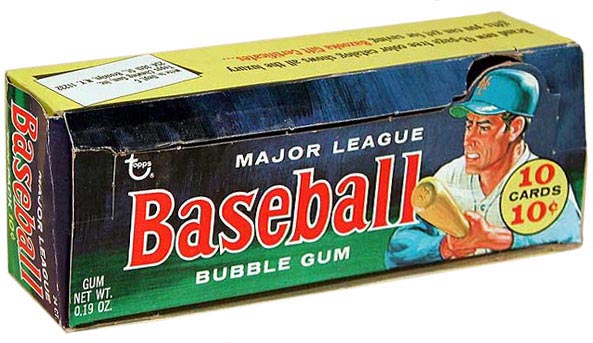
Today packs of cards sell for anywhere from $1 to $10 dollars. They were a dime at the candy store when I was a kid. You got 10 cards and a piece of bubble gum as stiff as linoleum. The gum combined with the cardboard cards to emit a wonderful, mystical smell that any guy over 60 will recognize immediately. We flipped the cards as I described in a past blog. (View You Threw Out What???) We also did deals to acquire players we really wanted. We had no way of knowing what players were in the packs we bought, and finding a Mickey Mantle, Duke Snyder or Willie Mays was pretty much hit or miss. I once gave 200 assorted cards in trade for a Mickey Mantle.

I kept my card collection in cigar boxes and shoe boxes, sorted out by function. I had "nobody" cards I used just for flipping or trading since I could afford to lose them. I had cards I would not flip or trade for anything. I also had cards that were valuable, but since I already had them, I would use them for high-powered trades. These cards were our kid currency. We treasured them, looked at them until they got dog-eared, and never thought for a minute about their monetary value. Collectors today so highly prize these cards that they keep them encased in plastic and almost never look at them. Doesn't sound like much fun to me, but then the older vintage cards sell for serious dough. A 1909 Honus Wagner recently sold at auction for a record $2.3 million.


As I sifted through my sons' cards, ball players names long forgotten flashed before my eyes. I even thought I got a familiar whiff of bubble gum coming off these 30-year old cards. After all my work I'll probably find out the collection isn't worth what I paid for the special boxes to store it in. No matter, it was worth the effort to give me a chance to think back on a hobby that gave me so much pleasure as a kid. And I stayed out of my wife's way.


CLICK ON DATES AT TOP RIGHT TO SEE OTHER “SPALDEEN DREAMS” POSTS. ALSO, READ MY OTHER BLOG: BRAINDROPS

LOOKING FOR A WORTHY CHARITY? TRY THESE FOLKS: Children's Craniofacial Association


Friday, January 14, 2011

The Mick

He came out of Commerce, Oklahoma in 1951, this shy, blond, strapping hick of a boy who would soon lay claim to the job then held by my idol, the legendary Joe DiMaggio of the New York Yankees. The Yanks, already blessed with an embarrassment of riches player-wise, got Mickey Mantle for the price of a train ticket to their Spring training camp. When you think of the signing bonuses paid to players today of far less ability, you wonder how much Mickey could have commanded if he was more savvy. Having already made a name for himself on the ball fields of Oklahoma, Mick was known for his two great abilities, normally mutually exclusive abilities in mere mortals: his blinding running speed and his home run power from either side of the plate.

After two years in the minors, Mantle burst on the scene in a Spring training game while the Yankees were on a west-coast swing through California, ironically Joe DiMaggio's home state. That day he hit two home runs over 500 feet, tripled with the bases loaded, and beat out an infield single that would have been an out for anyone else. Four hits and nine RBI's...not a bad day for the kid who would soon make Yankee fans forget Joe D. Mickey was a wild-throwing shortstop when he came to the Yankees. Casey Stengel, the great Yankee manager, drafted Tommy Henrich, a pretty fair outfielder himself, to teach Mantle how to play center field. A few weeks into the regular season, Mantle threw out a runner on third base who wandered too far off the bag after a routine outfield fly, thus completing the rare 9-6 double play. "I think my work here is done" said Henrich.

Mantle came up at a time when the aging, aching DiMaggio was on his last legs. Joe D. resented the new kid a bit, and made no bones about it. I learned later in life that DiMaggio had a dark side, but as a kid he could do no wrong in my eyes. I didn't think there was a ball player alive who could step into the Yankee Clipper's spikes, but Mickey soon proved me wrong. His talents were prodigious, impressing even the veteran Yankee players for whom winning was a habit. They had never seen the likes of Mantle, and gathered around the batting cage like little kids to watch him launch balls over the wall. Branch Rickey, the man who would later bring Jackie Robinson to the Brooklyn Dodger organization, was a part owner of the Pittsburgh Pirates in 1951. He sent a joking telegram to Yankee owner Del Webb asking him to name his price for Mantle. Webb wired back: "Ralph Kiner and half a million dollars."

There is no point in rehashing Mickey Mantle's stats with the Yankees; they are well known in baseball lore. Still, fans in bars everywhere argue how much better he could have been had he not been forced to play in debilitating pain for much of his career after catching a spike in one of the outfield drains in Yankee Stadium. Such an injury would probably have ended the playing days of ordinary men, but Mantle was far from ordinary. He slowed a bit, but continued to put up numbers that helped carry the Yankees to ten pennants and seven World Series crowns during his years with the team. People came to Yankee Stadium to see Mickey play, period. Whether he was flying from first to third on a base hit, running down a hard liner to right-center, or blasting baseballs into the stratosphere, Mickey rarely disappointed.

Later in his life The Mick showed a dark side that fueled a dozen tell-all books about him. His off-the-field exploits with teammate hell raisers Billy Martin and Whitey Ford were well documented on sports pages everywhere. Soon Mickey led the league in chasing women and trashing bars, but at the time all that mattered was what you did on the field. Maybe Mick got too many passes from fans and writers alike. Had he been held more accountable for his behavior he might be alive today. After becoming 'Sports Director' for an Atlantic City casino in 1983, and later owning a bar of his own in Manhattan, Mantle's ongoing battles with booze eventually caused his death from alcohol-related liver cancer.

Shortly before he died in August 1995, Mantle, now no more than a husk of a man, delivered a handwritten speech on national television. Mantle thanked fans for their cards and flowers, and urged youngsters to avoid the temptations faced by athletes. "To all my little teammates out there, please don't do drugs and alcohol," Mantle urged. "God only gave us one body. Take care of it." We don't want to remember our idols with feet of clay, and so I will remember Mickey as the muscular, boyish farm boy who roared out of Commerce, Oklahoma and set the baseball world on its ear. That 100-watt grin that lit up the room, the rippling muscles developed not in a gym but working in the oil fields, and those gimpy, heavily taped legs that carried his body around the bases after smacking another tape-measure home run...those are the things that will stay with me. The Mick may have been a flawed hero, but he was our hero.


CLICK ON DATES AT TOP RIGHT TO SEE OTHER “SPALDEEN DREAMS” POSTS. ALSO, READ MY OTHER BLOG: BRAINDROPS


LOOKING FOR A WORTHY CHARITY? TRY THESE FOLKS: Children's Craniofacial Association


Tuesday, January 4, 2011

What Do You Want to Be When You Grow Up?

As kids we sometimes talked about what we would become when we grew to adulthood. Most of us had no clue. It's amazing when you think about it that such an important decision was given so little thought. We all knew we had to go to high school, but after that, who knew? Few families in the neighborhood could afford college for their children. Most were counting the days until kids living at home could get jobs and start helping out with the expenses. Girls with no special calling thought about being secretaries or working as telephone operators. For the guys it was either a laborer or an office job. We did have some cops, firemen, teachers and nurses, but most of us just drifted into any job we could get.

Today, high schools have counsellors and college recruiters to help seniors decide on a career. When I went to high school, if you saw the guidance counsellor, it usually meant you were in trouble. I attended Brooklyn Tech, considered a very good school then and now. The first two years of study were general academics, but starting in junior year, students selected a tailored course of study to prepare them either for college or a job. Some of the specialized tracks included Electrical, Chemical, Mechanical, Structural and Architectural. I picked Industrial Design because I loved to draw and I was good at it. Unfortunately not enough juniors chose that track and so Tech did not offer it that year. I wound up in the Aeronautical track, God knows why, and I hated it. I was turned off to school and scraped through my remaining high school years.

My first job out of high school was for Bankers Trust Company on 46th Street in Manhattan. The pay was a fast $52 bucks a week, but they gave every employee a free checking account. I thought I died and went to heaven. The part about a checking account that did not sink into my teenage brain was the need to actually have money in the account before writing the checks. I think some of the checks I wrote back then are still bouncing. The job was boring but I met a bunch of guys that became good friends. We could be found most Friday nights in Johnny's Bar across the street blowing off the pressures of the week and trying to impress girls; we rarely succeeded.

Thanks to a tip from a neighborhood friend, I applied for a job with the Standard Register Company based in Dayton, Ohio. They sold business forms and equipment, and had an opening for a forms designer. The drawing skills I had honed at Brooklyn Tech came in very handy, and I got the job. I later went into sales and worked out of their office in Roslyn, Long Island. I recently received a call from a co-worker of mine at Standard Register named Mike Giorgio. He says he was just calling around to try to locate some old friends and wants to have a drink. I liked Mike and will join him for a drink...I'm just suspicious that he's got some pyramid scheme going and is looking for victims. That's me, glass half empty.

I soon realized that the jobs I was working were dead end, and with a nudge from my wife, started evening college classes. Eventually I got a Masters Degree in Business Administration from Bernard Baruch College back in the days when you needed more than just a pulse to graduate. I had a very satisfying career with Con Edison, and have worked as a part-time consultant for them since I retired ten years ago. I sometimes wonder what turn my life would have taken if I had completed the Industrial Design study track back at Brooklyn Tech. We like to think we have control over our lives, but more often than not, some chance event alters our fate and there is no going back. All in all, no complaints.


CLICK ON DATES AT TOP RIGHT TO SEE OTHER “SPALDEEN DREAMS” POSTS. ALSO, READ MY OTHER BLOG: BRAINDROPS

LOOKING FOR A WORTHY CHARITY? TRY THESE FOLKS: Children's Craniofacial Association