Thursday, February 3, 2011

Saved by the Books

I have written in an earlier post about my local Public Library branch on Saratoga Avenue and Macon Street in Brooklyn (View "At the "Liberry"). When I think about how people's reading habits have changed today, I'm reminded of what an important part this old building played in my life when I was young. Before there were electronic Kindles, Nooks and i-Books, there were neighborhood libraries with dusty shelves, shushing librarians, and the most wonderful array of books any boy could hope for. Those books had some years on them, and gave off a pleasantly musty smell that is missing from modern-day libraries.

My local library branch in Staten Island features lots of computers, books on CDs, and online books you can download to your MP-3 player, but has very few actual books on its shelves. Where are the card catalogs in the wooden drawers that held the keys to adventure, romance, literature, history and biographies? What happened to the quiet place I remember where people whispered out of respect to those who were reading or studying? My library has turned into a noise-filled place where people feel free to eat, drink, and converse in loud voices using the worst street language, while indifferent librarians go about their business as if it was none of their affair.

Honestly, as a kid, I could have gone either way. My Catholic school education pulled me toward the angels, but the influence of our rough and tumble neighborhood tried to nudge me in the other direction. I led a sort of double life, trying my best to excel in the classroom because I honestly loved learning, while at the same time maintaining my street creds by running with the guys and doing some stupid things I now regret. Among the most positive influences for good in my conflicted young life were my parents and teachers of course, but right after them I would rank the local library and the doors it opened for me.

I almost had to sneak down there for fear someone would find out and put out the word that I was a "bookworm", the worst thing one Brooklyn kid could call another. My parents were not readers so there were very few books in our house. I think the grade readers we read aloud in school were the first books to excite my curiosity. In the upper grades we were assigned book reports on classics like The Red Badge of Courage and Tom Sawyer. A lot of kids took the "Classic Comics" shortcut, but I pored over these books from cover to cover marveling at how the authors could spin such compelling tales. Soon I began to read for fun, a habit that stayed with me, and which inspired a love affair with words that continues to this day.

I'm a little sad that the library I knew as a boy is pretty much gone. Probably fifty years from now, today's kids will be moaning about how they miss their electronic books and laptop computers. By then publishers will be downloading books right to the chip imbedded in the brains of all newborns. You'll just have to think about what book you want to read, and presto, the software in your head will disgorge it. I understand that you can't stop progress, hell even I enjoy listening to books on CD in my car, but I think back to that building on Saratoga Avenue, and see myself sitting there in my black leather jacket and motorcycle boots engrossed in a book about a boy my age; I see the Civil War through his eyes and try to imagine what it must have been like. Maybe that magical sense of wonder only happens for the young.


CLICK ON DATES AT TOP RIGHT TO SEE OTHER “SPALDEEN DREAMS” POSTS. ALSO, READ MY OTHER BLOG: BRAINDROPS

LOOKING FOR A WORTHY CHARITY? TRY THESE FOLKS: Children's Craniofacial Association


Thursday, January 27, 2011

It All Started at the Brooklyn Palace

I just came across a lovely piece of family history, a copy of the invitation to my parents' wedding. This document means a lot to me because it recalls to mind those people who were so special to me. "Mr. and Mrs. Pasquale Camardi and Mrs. Lucia Pantaleno request the honor of your presence at the marriage of their children Frances to Anthony." I got a funny feeling reading the words that pretty much set my life in motion. The date was set as Sunday, September 29, 1940. The world (and soon America too) was embroiled in World War II, but the Camardis and Pantalenos were throwing a party to help give the family something happy to think about for a while.

I can only imagine the excitement in the two households. Pretty and vivacious Frances, next to youngest of four children, lived at 2402 Dean Street in Brooklyn at the time of the wedding. The bride's address appeared on the invitation for some strange reason. Anna and Mary, Frances' sisters, must have been hovering around the bride to be, making last minute adjustments to her gown and telling her everything would be all right. Pasquale and Caterina, his wife, were probably nervous and hoping the day would go off without a hitch. Italians are very conscious about impressing the rest of the family on occasions like weddings, and I'm sure Grandpa dug deep wanting the best for his baby girl.

At Anthony's house things were probably noisy. My Dad's family tended to converse like they were speaking over the sound of a jet engine. Grandma Lucy may have been trying one last time to convince her son that Frances wasn't the right girl for him. She disliked my mother and didn't care who knew it. Dad's sister Mary, who sadly died before I got to know her, would have been trying to keep her large brood, mostly boys, from fighting with each other while her husband Nick sat outside on the stoop calmly smoking his trademark DiNoboli cigar. Dad's older brother Joe and his wife Mae would be having a couple of boilermakers before the wedding. Usually after the third drink they took off the gloves and the fight was on.

The reception was to start at 7 pm in a local place called the Brooklyn Palace, on Rockaway Avenue between Somers and Hull Streets. We lived around the corner from there when I was a kid and I don't remember this place at all; it must have closed by the time I was born. The affair would most likely have horrified wedding planners of today. I'm imagining a wooden dance floor surrounded by tables covered with trays of sandwiches...ham, salami and cappicola. There would have been pitchers of cold beer, and each table would have a bottle of rye or scotch along with mixers like ginger ale and club sodas for making "highballs", the popular drink of the day. Coffee would have been accompanied by a big tray cream puffs to supplement the wedding cake.

When I think of the elaborate, obscenely expensive weddings thrown today, I can't help but smile when I think of Fran and Tony's little affair. The music would have been supplied by local boys who had day jobs so they could make a living. All night Italian songs would have been interspersed with pop hits of the day. Good people who worked hard for their families threw their cares to the wind and jumped up laughing when the Tarantella was struck up. Kids, after having slipped a little vino at the table mixed with cream soda, would get a running start and then slide across the polished wooden floor between the dancers.


Just reading that wedding invitation conjured up all these images in my head and made for a few very warm, pleasant moments on a snowy winter day.

CLICK ON DATES AT TOP RIGHT TO SEE OTHER “SPALDEEN DREAMS” POSTS. ALSO, READ MY OTHER BLOG: BRAINDROPS

LOOKING FOR A WORTHY CHARITY? TRY THESE FOLKS: Children's Craniofacial Association

Monday, January 24, 2011

Calling All Cards

Today was freezing cold, so after our morning walk at the mall (very exciting) we came home to our warm house to stay. Usually when my wife and I are home at the same time, we fall back on a routine that seems to work for us. We have things we do together like eat, do crossword puzzles and watch TV, and things we do separately. It's a nice balance and helps keep us from tripping over each other. When the weather is so extreme it's an additional challenge since neither of us can do any of the outdoor activities we enjoy like messing around in the garden. On days like this I look for projects. Today I decided to start sorting out the baseball cards my sons collected during the 1980s and 1990s.

We have shoe boxes full of these cards made mostly by Topps. Some of the sets are boxed, that is, ordered by us from the manufacturer in complete sets for a given year. We have 5 of these along with hundreds of loose cards for 1980-1981 that I have sorted by team. We also have quite a few football and hockey cards, but these don't have the caché of baseball cards. It occurred to me that since they are just taking up space on my shelves, and my sons show no interest in them, I thought I would find out if any were valuable and give them the option of making some cash, something I know they are interested in. My timing is not great since baseball card collecting and values have fallen off in recent years.

The hobby peaked around the mid-90s when card values were at their highest. A number of factors helped kill card collecting: the 1994-95 baseball strike hurt the sport and the card industry; too many manufacturers flooded the market to compete with Topps, the company that once enjoyed a monopoly in the business...this created confusion in the market about card values; kids preferred to play video games rather than collect cards; the hobby became a big business as prices soared...people didn't just collect their favorite players for the fun of it but rather for their monetary value. Card shows sprang up where not only baseball cards were traded, but the shows were frequented by players past and present who cashed in on collector interest in cards. For a price they would sign your card, thereby starting the abominable practice of autograph selling.

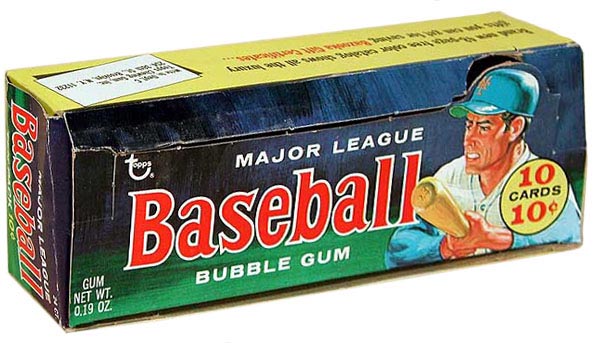
Today packs of cards sell for anywhere from $1 to $10 dollars. They were a dime at the candy store when I was a kid. You got 10 cards and a piece of bubble gum as stiff as linoleum. The gum combined with the cardboard cards to emit a wonderful, mystical smell that any guy over 60 will recognize immediately. We flipped the cards as I described in a past blog. (View You Threw Out What???) We also did deals to acquire players we really wanted. We had no way of knowing what players were in the packs we bought, and finding a Mickey Mantle, Duke Snyder or Willie Mays was pretty much hit or miss. I once gave 200 assorted cards in trade for a Mickey Mantle.

I kept my card collection in cigar boxes and shoe boxes, sorted out by function. I had "nobody" cards I used just for flipping or trading since I could afford to lose them. I had cards I would not flip or trade for anything. I also had cards that were valuable, but since I already had them, I would use them for high-powered trades. These cards were our kid currency. We treasured them, looked at them until they got dog-eared, and never thought for a minute about their monetary value. Collectors today so highly prize these cards that they keep them encased in plastic and almost never look at them. Doesn't sound like much fun to me, but then the older vintage cards sell for serious dough. A 1909 Honus Wagner recently sold at auction for a record $2.3 million.


As I sifted through my sons' cards, ball players names long forgotten flashed before my eyes. I even thought I got a familiar whiff of bubble gum coming off these 30-year old cards. After all my work I'll probably find out the collection isn't worth what I paid for the special boxes to store it in. No matter, it was worth the effort to give me a chance to think back on a hobby that gave me so much pleasure as a kid. And I stayed out of my wife's way.


CLICK ON DATES AT TOP RIGHT TO SEE OTHER “SPALDEEN DREAMS” POSTS. ALSO, READ MY OTHER BLOG: BRAINDROPS

LOOKING FOR A WORTHY CHARITY? TRY THESE FOLKS: Children's Craniofacial Association


Friday, January 14, 2011

The Mick

He came out of Commerce, Oklahoma in 1951, this shy, blond, strapping hick of a boy who would soon lay claim to the job then held by my idol, the legendary Joe DiMaggio of the New York Yankees. The Yanks, already blessed with an embarrassment of riches player-wise, got Mickey Mantle for the price of a train ticket to their Spring training camp. When you think of the signing bonuses paid to players today of far less ability, you wonder how much Mickey could have commanded if he was more savvy. Having already made a name for himself on the ball fields of Oklahoma, Mick was known for his two great abilities, normally mutually exclusive abilities in mere mortals: his blinding running speed and his home run power from either side of the plate.

After two years in the minors, Mantle burst on the scene in a Spring training game while the Yankees were on a west-coast swing through California, ironically Joe DiMaggio's home state. That day he hit two home runs over 500 feet, tripled with the bases loaded, and beat out an infield single that would have been an out for anyone else. Four hits and nine RBI's...not a bad day for the kid who would soon make Yankee fans forget Joe D. Mickey was a wild-throwing shortstop when he came to the Yankees. Casey Stengel, the great Yankee manager, drafted Tommy Henrich, a pretty fair outfielder himself, to teach Mantle how to play center field. A few weeks into the regular season, Mantle threw out a runner on third base who wandered too far off the bag after a routine outfield fly, thus completing the rare 9-6 double play. "I think my work here is done" said Henrich.

Mantle came up at a time when the aging, aching DiMaggio was on his last legs. Joe D. resented the new kid a bit, and made no bones about it. I learned later in life that DiMaggio had a dark side, but as a kid he could do no wrong in my eyes. I didn't think there was a ball player alive who could step into the Yankee Clipper's spikes, but Mickey soon proved me wrong. His talents were prodigious, impressing even the veteran Yankee players for whom winning was a habit. They had never seen the likes of Mantle, and gathered around the batting cage like little kids to watch him launch balls over the wall. Branch Rickey, the man who would later bring Jackie Robinson to the Brooklyn Dodger organization, was a part owner of the Pittsburgh Pirates in 1951. He sent a joking telegram to Yankee owner Del Webb asking him to name his price for Mantle. Webb wired back: "Ralph Kiner and half a million dollars."

There is no point in rehashing Mickey Mantle's stats with the Yankees; they are well known in baseball lore. Still, fans in bars everywhere argue how much better he could have been had he not been forced to play in debilitating pain for much of his career after catching a spike in one of the outfield drains in Yankee Stadium. Such an injury would probably have ended the playing days of ordinary men, but Mantle was far from ordinary. He slowed a bit, but continued to put up numbers that helped carry the Yankees to ten pennants and seven World Series crowns during his years with the team. People came to Yankee Stadium to see Mickey play, period. Whether he was flying from first to third on a base hit, running down a hard liner to right-center, or blasting baseballs into the stratosphere, Mickey rarely disappointed.

Later in his life The Mick showed a dark side that fueled a dozen tell-all books about him. His off-the-field exploits with teammate hell raisers Billy Martin and Whitey Ford were well documented on sports pages everywhere. Soon Mickey led the league in chasing women and trashing bars, but at the time all that mattered was what you did on the field. Maybe Mick got too many passes from fans and writers alike. Had he been held more accountable for his behavior he might be alive today. After becoming 'Sports Director' for an Atlantic City casino in 1983, and later owning a bar of his own in Manhattan, Mantle's ongoing battles with booze eventually caused his death from alcohol-related liver cancer.

Shortly before he died in August 1995, Mantle, now no more than a husk of a man, delivered a handwritten speech on national television. Mantle thanked fans for their cards and flowers, and urged youngsters to avoid the temptations faced by athletes. "To all my little teammates out there, please don't do drugs and alcohol," Mantle urged. "God only gave us one body. Take care of it." We don't want to remember our idols with feet of clay, and so I will remember Mickey as the muscular, boyish farm boy who roared out of Commerce, Oklahoma and set the baseball world on its ear. That 100-watt grin that lit up the room, the rippling muscles developed not in a gym but working in the oil fields, and those gimpy, heavily taped legs that carried his body around the bases after smacking another tape-measure home run...those are the things that will stay with me. The Mick may have been a flawed hero, but he was our hero.


CLICK ON DATES AT TOP RIGHT TO SEE OTHER “SPALDEEN DREAMS” POSTS. ALSO, READ MY OTHER BLOG: BRAINDROPS


LOOKING FOR A WORTHY CHARITY? TRY THESE FOLKS: Children's Craniofacial Association


Tuesday, January 4, 2011

What Do You Want to Be When You Grow Up?

As kids we sometimes talked about what we would become when we grew to adulthood. Most of us had no clue. It's amazing when you think about it that such an important decision was given so little thought. We all knew we had to go to high school, but after that, who knew? Few families in the neighborhood could afford college for their children. Most were counting the days until kids living at home could get jobs and start helping out with the expenses. Girls with no special calling thought about being secretaries or working as telephone operators. For the guys it was either a laborer or an office job. We did have some cops, firemen, teachers and nurses, but most of us just drifted into any job we could get.

Today, high schools have counsellors and college recruiters to help seniors decide on a career. When I went to high school, if you saw the guidance counsellor, it usually meant you were in trouble. I attended Brooklyn Tech, considered a very good school then and now. The first two years of study were general academics, but starting in junior year, students selected a tailored course of study to prepare them either for college or a job. Some of the specialized tracks included Electrical, Chemical, Mechanical, Structural and Architectural. I picked Industrial Design because I loved to draw and I was good at it. Unfortunately not enough juniors chose that track and so Tech did not offer it that year. I wound up in the Aeronautical track, God knows why, and I hated it. I was turned off to school and scraped through my remaining high school years.

My first job out of high school was for Bankers Trust Company on 46th Street in Manhattan. The pay was a fast $52 bucks a week, but they gave every employee a free checking account. I thought I died and went to heaven. The part about a checking account that did not sink into my teenage brain was the need to actually have money in the account before writing the checks. I think some of the checks I wrote back then are still bouncing. The job was boring but I met a bunch of guys that became good friends. We could be found most Friday nights in Johnny's Bar across the street blowing off the pressures of the week and trying to impress girls; we rarely succeeded.

Thanks to a tip from a neighborhood friend, I applied for a job with the Standard Register Company based in Dayton, Ohio. They sold business forms and equipment, and had an opening for a forms designer. The drawing skills I had honed at Brooklyn Tech came in very handy, and I got the job. I later went into sales and worked out of their office in Roslyn, Long Island. I recently received a call from a co-worker of mine at Standard Register named Mike Giorgio. He says he was just calling around to try to locate some old friends and wants to have a drink. I liked Mike and will join him for a drink...I'm just suspicious that he's got some pyramid scheme going and is looking for victims. That's me, glass half empty.

I soon realized that the jobs I was working were dead end, and with a nudge from my wife, started evening college classes. Eventually I got a Masters Degree in Business Administration from Bernard Baruch College back in the days when you needed more than just a pulse to graduate. I had a very satisfying career with Con Edison, and have worked as a part-time consultant for them since I retired ten years ago. I sometimes wonder what turn my life would have taken if I had completed the Industrial Design study track back at Brooklyn Tech. We like to think we have control over our lives, but more often than not, some chance event alters our fate and there is no going back. All in all, no complaints.


CLICK ON DATES AT TOP RIGHT TO SEE OTHER “SPALDEEN DREAMS” POSTS. ALSO, READ MY OTHER BLOG: BRAINDROPS

LOOKING FOR A WORTHY CHARITY? TRY THESE FOLKS: Children's Craniofacial Association


Wednesday, December 29, 2010

Snowbound

The blizzard of 2010 is over, and what a storm it was. New York City was totally unprepared for this and made the poorest response to a snow storm since Mayor John Lindsay back in 1969. Then, as now, the City's outer boroughs were forgotten while glitzy Manhattan, home to the fat cats, was handled as a priority. As I sit at the window watching my fellow Staten Islanders try to deal with 29 inches of un-plowed snow, my mind drifts back to the days when I actually liked the stuff. From the ages of 5 to 12, I enjoyed snow about as much as any city kid possibly could. The very things that annoy me about it now as an adult are what made it so appealing to me back then as a kid.

First, schools would close. That was in the day when mothers were mostly home caring for their families and not working like so many have to these days. Today, desperate parents show up at the school door expecting their kids to be admitted no matter the conditions. NYC schools almost never close any more, and when they do, people are outraged. In the 50's common sense prevailed. Why risk teacher and student safety when it was just simpler to have everyone stay home. The State allowed adequate snow days so why not use them. If there was no other reason to love snow as a kid, not having to go to school would have been enough.

Then there was the luxury of playing in the streets. Normally crowded with traffic, playing on a Brooklyn street could be hazardous to your health. Not that we didn't manage; we played stickball between cars, and if a play was in progress we just called time until the cars passed. City kids learn early to adapt. When it snowed it was a different story. Everything was white and quiet. Old fashioned wooden sleds with metal runners came out of the cellars and soon the streets were filled with kids belly-flopping down the block. We would "chain" the sleds together by having each kid hold onto the feet of the kid on the sled in front of him, and this sled train would go careening down the hill of the vacant lot right across the street since there were no cars to impede our progress.

Snow forts and snowball fights were mandatory. Our mothers were not used to having bored kids underfoot, and so they bundled us up in snow suits and sent us out into the drifts to play. Most homeowners shoveled their sidewalks and piled the snow near the curb, unlike the idiots today who throw it into the streets. These piles of snow became the rudimentary beginnings of elaborate snow forts, as they were added to by swarming boys eager to finish their fort before their enemies across the street could finish theirs. Towers were added, then ledges on which snowballs could be stored in preparation for an all-out attack. Small windows were poked into the walls so that the movements of the enemy could be observed.

When all was ready, war was declared. The rules of war were simple: no rocks packed inside snowballs, and no attacks if time was called due to injury. We were civilized after all. At first it was an artillery battle with each side lofting snowballs toward the enemy camp in hopes of hitting a random head that chose to peek at the wrong time. At some point, when one side sensed an advantage, an all-out assault was mounted. Garbage can covers provided excellent shields for the attacking forces as they overran the enemy position, pelting combatants with snowballs they carried in their pockets or just stopped and made on the spot. A successful raid ended by kicking down the other side's fort and burying them in their own defenses.

As violent and heated as these wars might sound, it was just play. It wasn't uncommon after the hostilities for both sides to join forces and build a snow tunnel along the sidewalk mounds, or line both sides of the street and hurl snowballs at any car that dared to drive down our block. Sometimes we had to rush home to change out of soaking wet snow suits and into dry ones. Our mothers, anxious to be rid of us, performed this maneuver like an Indy pit crew anxious to get their driver back out on the track. At the end of the day, exhausted but happy, we dragged ourselves home, put our wet gloves and hats on the radiator in the hall, and collapsed. If it was a good day, a mug of cocoa and steaming bowl of Campbell's Chicken Noodle Soup, salty enough to kill a horse, was waiting. Sublime.

I guess it's possible to use up one's supply of enthusiasm for anything. Maybe I hate snow so much today because of the intensity with which I loved it as a boy.


CLICK ON DATES AT TOP RIGHT TO SEE OTHER “SPALDEEN DREAMS” POSTS. ALSO, READ MY OTHER BLOG: BRAINDROPS

LOOKING FOR A WORTHY CHARITY? TRY THESE FOLKS: Children's Craniofacial Association


Thursday, December 2, 2010

The Russians Are Coming

Looking back to the days long ago when I was growing up in Brooklyn, it's tempting to put on the rose colored glasses. In reality, not everything was better then. We had childhood diseases like polio, our entertainment options were limited to the few snowy channels that came in on the old RCA console, there was no cell phone to call for help if your car broke down, and bigger problems existed that persist to this day like racial prejudice, gang fights (see racial prejudice), schoolyard bullying, economic downturns, and oh yes, the threat of nuclear war.

My Brooklyn neighborhood was mixed ethnically and racially. There were Irish, Italians, Germans, Jews, African Americans (called colored then) and a sprinkling of Hispanics and Slavs. I'm not saying it was a big love fest, but by and large we all got along. Then came the gangs. Whites resented blacks moving into the neighborhood, and prowled the streets in roving packs to keep them out. Blacks retaliated by making raids into white neighborhoods looking for white boys foolish enough to walk the streets alone at night. Whites fled in droves to Long Island to get away from the violence. I still carry around some racial prejudice from those difficult days. It was hard to watch neighborhood real estate prices plunge, and a ghetto develop where a nice, mixed, middle-class neighborhood used to be.

During the 1950s, there wasn't a block in the neighborhood that wasn't touched by one of the most dreaded childhood diseases of the time, polio. Also called infantile paralysis, polio struck seemingly at random. By 1950 the peak age incidence of "paralytic poliomyelitis" in the United States had shifted from infants to children aged five to nine years. It was not uncommon to see previously healthy children who used to run and play with you now wearing clumsy and painful leg braces. Frantic parents were terrified that their child would be next. Then God sent us a miracle man named Dr. Jonas Salk who, on April 12, 1955 announced the Salk vaccine, based on a polio virus grown in the lab and administered by injection. An orally administered version came out in 1958. The vaccine literally wiped out the disease, and a huge sigh of relief went up around the world.

The cold war raged in the 1950s as Russia and the United States played a dangerous game of brinksmanship. The movie "Dr. Strangelove" portrayed with dark humor the fears that prevailed at the time. In school, the brothers and the nuns drilled us in what to do if we were ever attacked by the godless heathen Russians. The first thing was to swallow your religious medal if you were wearing one, after all, what other reason was there for the Russians to invade us than to steal our religious medals. Next we were to duck and cover...kneel down under our wooden desks and cover our heads...what radiation fallout could penetrate that! In the streets there were public fallout shelters set up underground at various locations for people to go to in the event of an air raid. Knowing the high anxiety we endured back then, it's easy to understand why people my age don't usually complain about being searched at the airport. We almost welcome the grope.

Yes we had problems in the Fifites, but you know, we didn't obsess about them. Back then, by the time news was reported, most of the consequences of any possible threat were already past. We now live in an age of instant, over-sensationalized communication. Television is not content with just reporting the news, they must punch it up for a jaded audience with a five-second MTV attention span. And so a "chance of showers" becomes "a dangerous Noreaster"; or "two cases of West Nile virus" turns into "a possible city-wide epidemic"...you get the picture. Sometimes I think we were better off before all the electronic wolf-crying. Hey, I had my Lash Larue western comics and a fresh package of Yankee Doodles...Russians, do your worst!


CLICK ON DATES AT TOP RIGHT TO SEE OTHER “SPALDEEN DREAMS” POSTS. ALSO, READ MY OTHER BLOG: BRAINDROPS


LOOKING FOR A WORTHY CHARITY? TRY THESE FOLKS: Children's Craniofacial Association


Tuesday, November 23, 2010

A Special Day Remembered

I must have been around 10 years old when my Mom took me to the American Museum of Natural History. I don't recall if my sister was with us, and my younger brother had not yet made his appearance in the world. We didn't often get to go to places like this. My folks never owned a car so transportation was limited to subways and buses. I remember being impressed by the exterior of the Museum; I still am to this day. Shortly after its founding in 1869 by Albert Smith Bickmore, the Museum quickly outgrew its original location in the Central Park Arsenal and secured Manhattan Square, a block of land across the street from Central Park, between West 77th and 81st Streets. On June 2, 1874 the cornerstone for the Museum’s first building at 77th Street was laid by U.S. President Ulysses S. Grant. On December 22, 1877 the first building opened with U.S. President Rutherford B. Hayes presiding at a public ceremony.

Not to be outdone by its beautiful exterior, the exhibits and collections housed inside the Museum deliver everything a 10-year old boy could wish for. At the time, visitors were blown away as soon as they entered the lobby by a giant skeleton of Tyrannosaurus Rex, one of the largest dinosaurs that ever walked the earth. Most of the bones were real... fossilized Tyrannosaurus bones from two specimens discovered in Montana by Museum paleontologist Barnum Brown in 1902 and 1908. (I think it still stands there today, but posed differently now that we know more about how these creatures stood upright.) If I saw nothing else that day, the T-Rex alone would have justified the hour spent on the A train. My imagination was on fire five minutes into our visit.

I also vividly recall the dioramas set up in the Museum to entertain and enlighten as you walked the corridors on the 8 floors of the building. The Hall of Mammals with wild animals from all over the world in realistic poses and habitats; early man around the campfire; scenes of everyday life of Native Americans, Eskimos, Africans, Asians; the Hall of Ocean Life that brought the sea and all its creatures indoors; the Hall of North American Forests featuring a cross section of a giant sequoia tree over 1300 years old, showing historic events that were taking place as each ring on the tree was forming; it was really too much for a 10-year old to absorb. My poor mother was probably exhausted as I dragged her from exhibit to exhibit, yelling excitedly as we rounded each corner.


And then there was the Hayden Planetarium that opened in 1935. We walked into the dark theater and took our seats, not really knowing what to expect. As the lights went completely down and the show started, I became mesmerized. Remember, this was 1952, before the advent of space exploration and travel. The planets were flat images in a text book to most people, but the Planetarium show about the origins of the galaxy and planet earth changed all that. It was almost magical to me seeing the images of Mars, Saturn and shooting stars projected overhead in the night sky. I'd be willing to bet that the experience of seeing that show inspired more than one kid to pursue a career in science. I didn't want the show or the day to end, but it did. Mom took me to the snack bar for something to eat before we got back on the subway for the long trip back to Rockaway Avenue in Brooklyn.

I'm not sure what prompted Mom to make that trip with me in 1952. We didn't do many trips like that... maybe she thought I needed to have a little culture drummed into my barbarian head. I like to think she enjoyed herself, and that some of the things that fascinated me were of interest to her too. As kids, when we are doing things with our parents, like our family pilgrimage to Radio City Music Hall (
View Radio City Music Hall), or my father taking me to Yankee Stadium (View Where Have You Gone, Joe DiMaggio), we tend to take them for granted. It's only when our parents are gone and we think back on those special moments we shared, that we appreciate what they did for us. Thanks, Tony and Fran, for making time for me.


CLICK ON DATES AT TOP RIGHT TO SEE OTHER “SPALDEEN DREAMS” POSTS. ALSO, READ MY OTHER BLOG: BRAINDROPS

LOOKING FOR A WORTHY CHARITY? TRY THESE FOLKS: Children's Craniofacial Association


Tuesday, November 9, 2010

Little GTO

This past Saturday we were headed south on the New Jersey Turnpike to Philadelphia . We passed a long line of vintage Pontiacs... Bonnevilles, Catalinas, GTOs and Gran Prixs, all driving in a caravan probably to some antique car show where collectors gather to share their enthusiasm for one of America's iconic automobile brands. They were mostly older guys like me, trying to hang on a little longer to their youth. In the mid-fifties General Motors dominated the automotive world. GM was such an economic force that it's Chairman, Charles Wilson, after being appointed Eisenhower's Secretary of Defense, is reported to have said: "What's good for General Motors is good for the country."

In the 1950s, GM was the largest corporation in the Unites States. A job there was pretty much cradle to grave security, especially after the rise of the United Auto Workers Union under such dynamic leaders like Walter Reuther. Gradually, the cost of paying union members, including extremely generous benefits, began taking its toll. Moreover, ridiculous union work rules cut into the productivity of the American worker, adding to GM's burden. Finally, the bizarre Detroit manufacturing philosophy of "planned obsolescence", the process of a product becoming obsolete or non-functional after a certain period or amount of use in a way that is planned or designed by the manufacturer, was the last straw and the beginning of the end for GM. Looming on the horizon, ready to change the auto industry in ways GM never imagined, was an unknown company from the Land of the Rising Sun.

Around 1959, Nissan Motors began selling its small Datsun sedans. Consumers laughed. Management at GM and other major US automakers, in their supreme arrogance, scoffed at the Japanese cars. This was America, and everyone knew that bigger was better, at least that's what they bet the ranch on. They lost. The steady rise in gasoline prices made the economical Japanese imports more desirable than their gas-guzzling US counterparts for many Americans. While the big three Detroit automakers continued cranking out big cars loaded with bells and whistles, Nissan, and later Honda, Toyota and Volkswagen, slipped in under the radar and stole their market with compact, reliable little cars. The rest of the story you know.

In the fifties and sixties, each GM brand had its own strong identity. Every boy on my Brooklyn block could identify a GM car a block away, and many could recite the model and year as well. By the 80s, GM's various brands all started to look alike - it was hard to tell an Olds from a Buick or Pontiac - no more 'Rocket 88' swoopy styling - just another blandly engineered' GM product. Around the year 2000, GM abandoned its Oldsmobile brand. This past May the last Pontiac rolled off the assembly line, leaving general Motors just three of its iconic brands, Chevy, Buick and Cadillac. In 2008 GM received billions in bailout money from the government, with up to an additional $45 billion more in future tax credits. In 50 years the once largest corporation in the United States was on its knees, victimized by clueless management, greedy unions and skyrocketing gas prices.


As we drove by those classic Pontiac cars, what should have been a celebration of American automotive history became in my mind more like a funeral procession for a lost American industry. GM is finally making the kind of cars that Americans want, but we are now playing catch-up in a business we once ruled.


CLICK ON DATES AT TOP RIGHT TO SEE OTHER “SPALDEEN DREAMS” POSTS. ALSO, READ MY OTHER BLOG: BRAINDROPS


LOOKING FOR A WORTHY CHARITY? TRY THESE FOLKS: Children's Craniofacial Association


Monday, November 1, 2010

The Time Travelers

This weekend we took a trip in a time machine. Actually, we visited my son and daughter-in-law at their new digs in Philadelphia to help them paint and clean-up. The house is a vertical brownstone-style structure with four levels. It sits on Lombard Street in the beautiful Washington Square section of town, and reminds me so much of my old neighborhood in Brooklyn. The row houses are very similar to the ones I grew up in, maybe a little fancier.

What I love about the area is that it is a real neighborhood. Residential homes are mixed in with restaurants, stores and parks. People actually walk from place to place. It almost has a European feel with cobblestone streets, flower boxes in the windows, and beautiful ironwork gates and doors. The population looks like a mix of old timers who were born in and will die in the neighborhood, business people who want to live near where they work, tourists who come to see the Liberty Bell, young Yuppie couples with little Yuppie kids, and ethnic folk of all kinds living together. Too many neighborhoods like this one fell to urban blight, but you get the feeling that won't happen here.

A short walk away is the Italian market where familiar foods can be found fresh. These are not the mega stores that you need a map to get around in, but mom and pop operations that have been in the same families for generations. Men sit outside on sidewalks or under trees playing cards, drinking coffee and solving the problems of the world, while never missing a pretty girl that may walk by. We had dinner at a BYO trattoria called Giorgio's on Pine (located on Pine Street). The place was cozy, the food great and the owner very solicitous.

The local church is really two churches that combine to serve the parish, St. Paul's, and around the corner, St. Mary Magdalen de Pazzi, the oldest Catholic-Italian church in America. St. Paul's was also built with contributions primarily from Italian parishioners, as the benefactor plaque in the lobby shows...mostly last names ending in vowels. The interior of the church was filled with statues, many with Italian connections like St. Rocco who, though born in France, spent some years in Italy. The statue of Saint Rocco, patron saint of plague victims, is considered unique among theologians because of his pose; it depicts him with his left hand pointing to an open sore on his left leg. Few images of saints expose any afflictions or handicaps.

Real neighborhoods are hard to find any more. So many of us live in the suburbs where neighbors don't know one another, and people who walk the streets are eyed suspiciously from behind closed curtains. I remember walking down my block and knowing at least two-thirds of the people by name, and they me. People swept and hosed off their sidewalks, and would nod hello to anyone who passed. Sitting on stoops and trading gossip was raised to an art form. The local barber knew how you wanted your hair cut, the butcher would save you a nice cut of meat he knew you liked, and the bartender would be readying your drink before your behind hit the bar stool.

If you miss this kind of neighborhood, take a time machine trip to South Philly and revel in it like I did.


CLICK ON DATES AT TOP RIGHT TO SEE OTHER “SPALDEEN DREAMS” POSTS. ALSO, READ MY OTHER BLOG: BRAINDROPS


LOOKING FOR A WORTHY CHARITY? TRY THESE FOLKS: Children's Craniofacial Association